
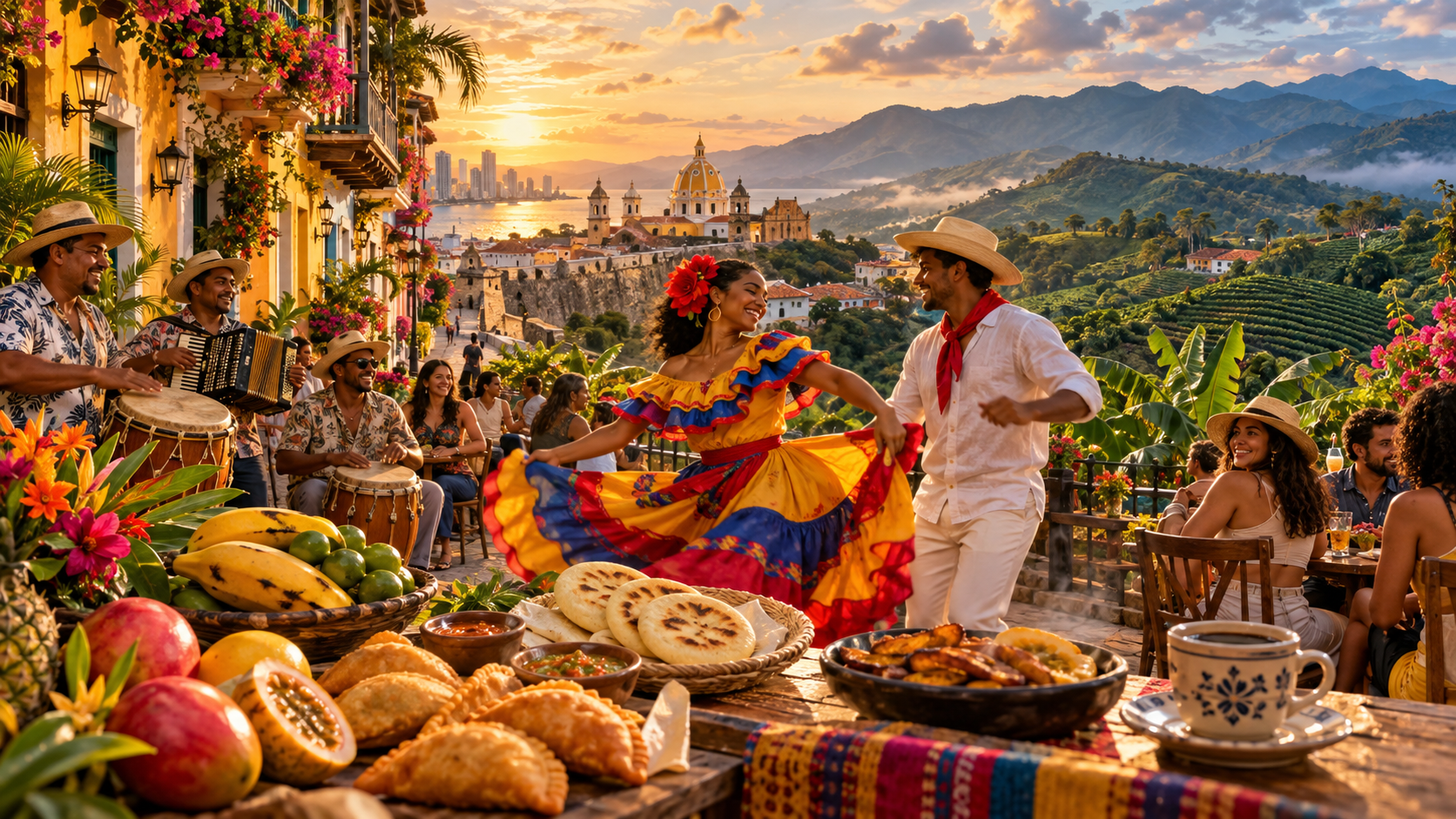
Ask someone in the United States what comes to mind when they hear Colombia and the answers tend to arrive quickly: coffee, salsa, colorful streets, Cartagena, maybe arepas.
None of that is wrong.
It is just wildly incomplete.
Colombia culture changes as you move across the country. The Caribbean coast does not feel like Bogotá. Medellín has a different rhythm from Cali. The coffee-growing mountains have their own traditions, while the Pacific coast carries strong Afro-Colombian musical and culinary influences. Travel toward the plains, Amazon or Indigenous territories and the picture changes again.
That is the first thing worth understanding.
There is no single Colombian accent, dish, dance or way of celebrating.
Instead, Colombia feels like several cultural worlds stitched together by language, family ties, music, food and a strong habit of turning ordinary gatherings into social events.
And yes, coffee matters. But probably not in the way you think.
Colombia is a country of regions, not one giant cultural block
Colombia has six commonly recognized natural regions: the Andean, Caribbean, Pacific, Orinoquía, Amazon and Insular regions.
Geography shapes culture here more than many first-time visitors expect.
The Andes split into three mountain ranges across the country, creating valleys and high-altitude cities. The Caribbean coast is hotter, flatter and culturally connected with music such as cumbia and vallenato. The Pacific is lush, rainy and strongly shaped by Afro-Colombian communities. The eastern plains open into the Llanos, where cattle culture and work songs have deep roots.
Put simply, travel a few hundred miles and everyday life can change dramatically.
| Region | Common Cultural Associations | What Visitors Often Notice |
|---|---|---|
| Caribbean | Cumbia, vallenato, Carnival, coastal food | Heat, music, bright color and an outdoor social rhythm |
| Andean | Coffee culture, mountain towns, major cities | Cooler climates and strong regional identities |
| Pacific | Marimba music, Afro-Colombian traditions, seafood | Lush landscapes and music tied closely to community life |
| Orinoquía | Llanero culture, cattle work, harp music | Open plains and strong ranching traditions |
| Amazon | Indigenous cultures and forest knowledge | Communities with very different relationships to land and nature |
| Insular | Island traditions, Caribbean influences | Creole culture, seafood and a different linguistic mix |
This is why saying “Colombians eat this” or “Colombians dance like that” usually needs a footnote.
Which Colombians? Where?
Music is not background noise here
If you want a shortcut into Colombia culture, listen before you look.
Music is everywhere.
Not literally every second of the day, obviously. But compared with many parts of the United States, music often feels more woven into social life.
Family gatherings, neighborhood celebrations, festivals and parties tend to involve dancing sooner or later.
Different regions have different sounds.
Cumbia developed along the Caribbean coast through Indigenous, African and European cultural influences. Its percussion, movement and distinctive rhythm eventually became one of Colombia’s most internationally recognizable musical forms.
Vallenato also comes from the Caribbean region and traditionally centers on accordion, caja drum and guacharaca. Its songs often tell stories – love, travel, heartbreak, local life, people and places.
It is basically storytelling with an accordion that refuses to stay quiet.
Then there is salsa.
Salsa did not originate in Colombia, but Cali became one of the world’s major salsa cities. The city’s dance style is fast, energetic and famously footwork-heavy.
Watching experienced dancers in Cali can make you question whether everyone else received a second pair of ankles at birth.
The Pacific has its own musical world
On Colombia’s Pacific coast, marimba music, traditional songs and dance reflect long-standing Afro-Colombian cultural traditions.
Wooden marimbas, drums and vocal music often play central roles.
These traditions are not simply entertainment created for visitors. They are tied to celebrations, community gatherings, family memory and local identity.
That distinction matters.
Tourists often encounter culture on a stage. Communities usually experience culture long before anyone buys a ticket.
UNESCO recognizes marimba music and the traditional chants and dances of Colombia’s South Pacific region as part of the world’s intangible cultural heritage.
It is one example of how musical traditions in Colombia carry social memory as much as melody.
And yes, Colombians really do dance a lot
But here is the nuance.
Not every Colombian can salsa.
Not everyone wants to dance.
And no, arriving in Bogotá does not mean strangers immediately form a dance circle around you.
Still, dancing is a normal part of social culture in a way that can feel more natural than it does for many Americans.
You may see:
- couples dancing salsa at clubs in Cali;
- vallenato playing at family parties along the Caribbean coast;
- cumbia performances during festivals and public events;
- reggaeton and contemporary Latin music dominating younger nightlife scenes;
- traditional regional dances appearing at local celebrations and cultural festivals.
And here’s the important part: old and new do not cancel each other out.
A person can listen to vallenato with their parents, reggaeton with friends and international pop at the gym.
Culture rarely stays in one neat box.
Food changes almost every time the landscape changes
There is no single Colombian national plate that explains the whole country.
Arepas get close to being universally recognizable, but even they change by region.
Some are thick. Some are thin. Some contain cheese. Others are served almost plain beside eggs, meat or soup.
Ask five Colombians how an arepa should be made and you may accidentally start a sixth conversation about which region does it correctly.
Bogotá is strongly associated with ajiaco, a chicken and potato soup traditionally made with several varieties of potatoes, corn and guascas, an herb that gives the soup its distinctive flavor.
Antioquia is known for bandeja paisa, a generous plate that can include beans, rice, ground meat, chicharrón, egg, plantain, avocado and arepa.
On the Caribbean coast, coconut rice, fried fish and plantain show up regularly.
Pacific cuisine leans heavily on seafood, coconut and regional ingredients.
And then there are soups.
Colombia takes soup more seriously than many visitors expect.
A warm bowl at breakfast or lunch is not unusual, depending on the region and family.
What should a curious first-time visitor eat?
Start broad rather than hunting one supposedly essential dish.
- Try arepas in more than one region because they are not all the same.
- Eat ajiaco in Bogotá if you want a dish strongly tied to the capital.
- Order bandeja paisa in Antioquia when you are genuinely hungry.
- Look for coastal fish, coconut rice and patacones near the Caribbean.
- Try empanadas from a casual local spot rather than assuming one recipe represents the country.
- Drink fresh fruit juices made with fruits you may barely see in U.S. supermarkets.
The fruit situation deserves its own paragraph, by the way.
Colombia has an enormous range of tropical and highland fruits. Lulo, guanábana, maracuyá, granadilla, guava and tree tomato are just the beginning.
Ordering juice can become an accidental tasting menu.
Coffee is a crop, a ritual and part of national identity
This is probably the Colombian cultural symbol Americans know best.
Colombian coffee has been marketed internationally for decades, but the cultural story is much richer than the bag sitting on a grocery shelf.
Much of the country’s coffee grows in mountainous areas where small farms operate on steep slopes.
The Coffee Cultural Landscape of Colombia, recognized by UNESCO, represents a living agricultural landscape shaped over generations by coffee-growing families.
It includes farms, towns, architecture and social traditions tied to coffee production.
And here’s something visitors sometimes find funny: Colombia has a strong coffee-growing identity, but traditional everyday coffee is not always the fancy pour-over experience Americans associate with specialty cafés.
A simple tinto – a small black coffee – is common.
You may drink one at a café, bakery, roadside stop or while talking to someone who has no interest in discussing tasting notes involving jasmine and blueberry.
Specialty coffee culture has grown strongly in Colombian cities too, so both worlds now sit side by side.
Family life tends to be visible
Family plays an important role in Colombian social culture.
Again, that does not mean every household works the same way. Cities, generations and individual families vary enormously.
But extended family relationships often remain active.
Birthdays, Sundays, holidays and casual visits may bring together grandparents, cousins, aunts, uncles and friends who function almost like relatives.
Americans used to highly scheduled social lives may notice that family gatherings can feel more fluid.
Someone arrives late. Someone else brings another person. Food appears. Music starts. A quick visit becomes four hours.
No one seems particularly alarmed.
Hospitality often works in this same informal way.
Offering coffee, juice or food to a visitor is common, especially in homes.
Colombian Spanish is not one accent either
Spanish is Colombia’s official language, but regional accents vary dramatically.
Bogotá speech sounds different from coastal Spanish. Paisa speech in Medellín and Antioquia has its own rhythm and vocabulary. Cali sounds different again.
On the Caribbean coast, speech can be faster, with sounds dropped or softened in ways that challenge learners who felt extremely confident after completing a language app.
There are also more than 60 Indigenous languages spoken in Colombia.
So even linguistically, the country is far less uniform than a map might suggest.
You may also hear regional forms of address such as usted, tú or vos used in ways that shift from place to place.
Spanish learners, welcome to the fun part.
Festivals are one of the easiest ways to see culture in motion
Colombia has an enormous calendar of public celebrations.
Some are religious. Others are connected with regional identity, music, flowers, history or agricultural life.
Barranquilla Carnival is the heavyweight.
Held before Lent on the Caribbean coast, it combines parades, music, masks, dance, costumes and traditions with deep regional roots.
It is recognized by UNESCO as intangible cultural heritage.
But it is only one major celebration.
| Festival or Tradition | Location | What Makes It Distinctive |
|---|---|---|
| Carnival of Barranquilla | Barranquilla | Parades, costumes, cumbia, dance and Caribbean traditions |
| Black and White Carnival | Pasto | Large public celebrations, elaborate artistic displays and regional identity |
| Feria de las Flores | Medellín | Flowers, silleteros and Antioquian traditions |
| Feria de Cali | Cali | Salsa, concerts, dancing and citywide festivities |
| Festival of Saint Francis of Assisi | Quibdó | Religious and Afro-Colombian community traditions |
The mistake would be viewing these only as giant parties.
Festivals often preserve music, crafts, costumes, oral traditions and community memories that might otherwise disappear.
Medellín’s flower culture goes deeper than pretty displays
The Feria de las Flores is closely connected with the silletero tradition.
Silleteros carry elaborate floral arrangements on wooden frames called silletas.
The practice is tied to farming communities around Medellín, particularly Santa Elena.
Today the floral displays can be huge and highly artistic, but the tradition connects back to rural life and the ways people once transported goods through mountain terrain.
This is one of those Colombian traditions that becomes much more interesting once you know there is a practical story behind the spectacle.
Cartagena shows the Caribbean layer of Colombian culture
Cartagena is famous for colorful colonial buildings and stone walls, but reducing it to pretty architecture misses the point.
The city has deep African, Indigenous, European and Caribbean influences.
Food, music, language and neighborhood traditions reflect that history.
One cultural symbol visitors often encounter is the palenquera – women wearing bright traditional dresses and carrying bowls or baskets of fruit.
The visual image is strongly associated with Cartagena tourism, but its roots connect to San Basilio de Palenque, a community southeast of the city with a remarkable Afro-Colombian history.
The cultural space of Palenque de San Basilio is recognized by UNESCO for its social, musical, linguistic and cultural traditions.
So yes, the colorful clothing makes a great photo.
But there is a story behind it.
Art in Colombia is not limited to Botero
Fernando Botero is probably the Colombian artist most Americans recognize immediately.
His exaggerated, voluminous figures appear in paintings and sculptures around the world, and Medellín has a particularly visible connection with his work.
But Colombian art extends much further.
Major cities support contemporary galleries, street art, photography, Indigenous crafts and design communities.
Bogotá has become especially known for urban art.
Murals can cover entire building walls, and street art tours have become a popular way for visitors to understand neighborhoods through visual culture.
Still, don’t treat every mural like free wallpaper for a selfie.
Some pieces address community identity, displacement, memory or social issues. Context matters.
Craft traditions change from region to region
Colombia has strong craft traditions involving weaving, ceramics, basketry, jewelry, wood and plant fibers.
One of the most recognizable objects is the mochila woven by Indigenous communities such as the Wayuu.
Authentic bags can involve long hours of work, and patterns may reflect cultural traditions rather than simply fashion trends.
Other regional crafts include sombreros, woven baskets, ceramics and the elaborate Pasto varnish tradition known as mopa-mopa.
For travelers buying crafts, the simplest rule is useful:
- learn who made the item when possible;
- buy directly from artisans or reputable cooperatives;
- do not assume handmade work should cost the same as mass-produced souvenirs;
- ask before photographing artisans closely while they work;
- remember that traditional designs may carry cultural meaning beyond decoration.
A handmade object is not just a cheaper version of something from a design store.
The labor is the point.
Everyday politeness feels warm but fairly structured
Greetings matter.
People commonly acknowledge others when entering small shops, elevators, waiting rooms or other shared spaces.
A simple buenos días, buenas tardes or buenas noches goes a long way.
In social settings, cheek kisses, handshakes or hugs may be common depending on the relationship and context.
Foreign visitors do not need to imitate every gesture perfectly.
Just avoid acting like everyone around you is invisible.
Basic warmth matters more than flawless etiquette.
Time can feel a little more flexible socially
This is one of those subjects where stereotypes can get silly fast.
Business meetings and flights still have clocks.
Restaurants have reservations. People go to work. Doctors have schedules.
But informal social timing may feel less rigid than some Americans expect.
A party listed at 8 p.m. may not reach full energy at 8:05.
Friends might say they are “on the way” while still finishing something at home.
And a lunch can become longer than planned.
The key is context.
Do not treat relaxed social timing as a universal rule for every Colombian situation.
Religion still shapes some traditions even as society changes
Catholicism has historically had a major cultural influence in Colombia.
You see it in church architecture, holidays, processions, family customs and town festivals.
Holy Week celebrations in Popayán are among the country’s best-known religious traditions and have UNESCO recognition.
At the same time, modern Colombia is religiously diverse and increasingly varied in how people relate to faith.
Some participate deeply. Others treat holidays mostly as family traditions. Others follow different religions or none.
Again, the country refuses to fit into one neat cultural box.
What Americans often misunderstand about Colombia culture
The first mistake is treating the country as culturally Caribbean.
The Caribbean is important, but Colombia stretches from tropical coastlines to cold Andean cities and Amazon rainforest.
The second mistake is assuming salsa is the national dance and everyone knows how to do it.
Cali might forgive you for thinking that. Bogotá probably will not.
The third mistake is reducing Colombian food to arepas and coffee.
Regional cuisine is much broader, and even familiar foods change from place to place.
And the fourth mistake?
Thinking modern culture replaced traditional culture.
It didn’t.
In Colombia, old and new often sit at the same table.
A grandmother may prepare a regional dish while her grandchildren film TikToks in the next room. A traditional festival can exist beside modern nightlife. Young musicians sample folk rhythms in electronic tracks.
Culture moves. That’s what keeps it alive.
FAQ About Colombia Culture
What is Colombia culture known for?
Colombia is known for its regional music, dance, coffee traditions, festivals, diverse food, family-centered social life, crafts and a cultural mix shaped by Indigenous, African and European roots.
What music is traditional in Colombia?
Cumbia and vallenato are among the best-known traditions, but Colombia also has marimba music from the Pacific, joropo from the plains and many regional styles. Salsa has a particularly strong presence in Cali.
What food is typical in Colombia?
It depends heavily on the region. Common examples include arepas, ajiaco, bandeja paisa, empanadas, soups, rice dishes, fried plantains, seafood and a wide range of tropical fruits.
Why is coffee important to Colombian culture?
Coffee farming has shaped the economy, landscapes, architecture and community life of several mountain regions. The Coffee Cultural Landscape of Colombia is recognized as a UNESCO World Heritage property.
What is the biggest festival in Colombia?
The Carnival of Barranquilla is one of the country’s largest and most famous celebrations. It combines music, dance, parades, costumes and Caribbean traditions.
Is Colombian culture the same everywhere in the country?
No. Colombia has major regional differences in accent, food, music, climate, history and traditions. Caribbean, Andean, Pacific, Amazonian and plains cultures can feel very different from one another.
What should visitors know about Colombian etiquette?
Greeting people matters, hospitality is common and social interactions can be warm. A simple buenos días or buenas tardes is useful, and visitors should follow local cues rather than assuming every region behaves the same way.
Colombia Culture Is Really About the Differences
The easiest way to misunderstand Colombia is to look for one defining cultural image.
There isn’t one.
You could pick coffee, but that would leave out the Caribbean.
You could pick salsa, but that would ignore half the country’s musical traditions.
You could pick Cartagena’s bright balconies, but Bogotá wakes up under gray mountain skies thousands of feet above sea level and feels like another country entirely.
That contrast is the story.
Colombia culture comes from geography, migration, Indigenous traditions, African heritage, European influence, agriculture, cities, music and local pride. It changes by region but still feels connected.
You see that connection around a table.
Someone offers coffee.
Another person brings food.
Music appears.
A quick visit becomes a long conversation.
And before you realize what happened, you have learned more about the country from one afternoon with people than you could from a dozen travel brochures.
So yes, learn about cumbia. Drink good coffee. Eat an arepa. Go to a festival if the timing works.
But pay attention to the smaller things too.
The greeting when someone enters a room. The regional word you have never heard before. The argument about whose hometown makes the better version of a dish. The music someone plays because their parents played it. The family recipe that never had exact measurements.
That is where Colombia culture becomes real.
Not in one symbol.
In all the differences living together.

Leave a Reply