
The Amalfi Coast looks suspiciously perfect in photos.
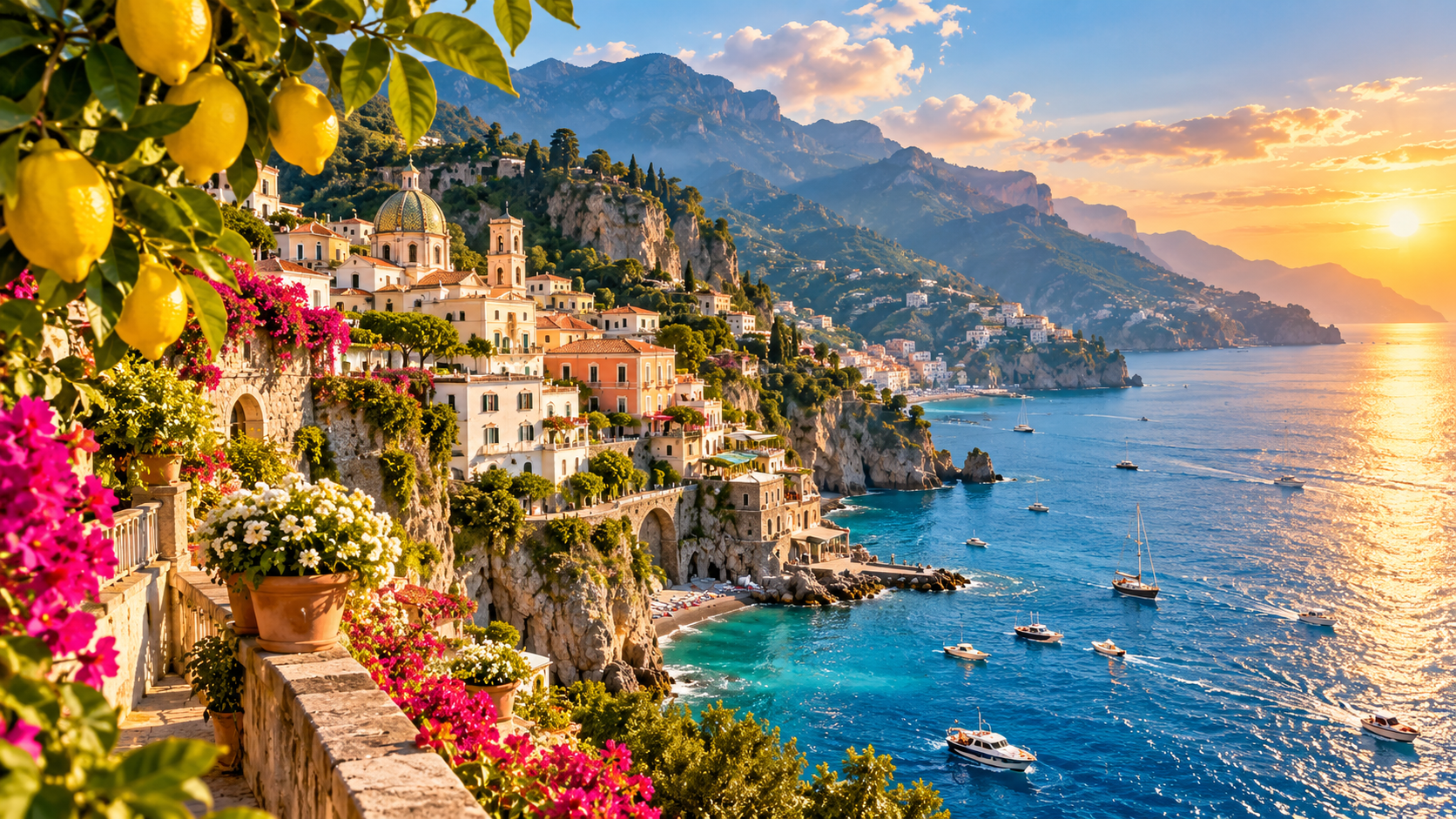
Pastel houses tumble down cliffs. Lemon trees grow on terraces that seem to have no business existing on such steep slopes. Little beaches hide between rocks, boats float over intensely blue water, and somewhere above it all sits a restaurant terrace where lunch appears to last three hours.
Then you arrive and discover another side of the story.
There are stairs. So many stairs. Roads twist around cliffs with barely enough room for two vehicles. A town that looks five minutes away may require a bus, a ferry and a sweaty uphill walk. Positano is beautiful, yes, but carrying a suitcase through it can suddenly make you question every packing decision you’ve ever made.
And yet, somehow, the place still works its magic.
For American travelers researching amalfi coast italy, the trick is understanding what kind of destination this actually is. It is not one beach town. It is not a resort strip. And it is definitely not a place where you should plan seven attractions before lunch.
The Amalfi Coast is a steep cultural landscape on the southern side of Italy’s Sorrentine Peninsula in Campania. Historic towns sit between the Lattari Mountains and the Tyrrhenian Sea, linked by roads, paths and seasonal or year-round boat services depending on route and conditions.
UNESCO added the Costiera Amalfitana to the World Heritage List in 1997 for the way settlements, terraced agriculture and the dramatic natural landscape developed together.
In plain English: people somehow built towns, gardens and farms on cliffs, and the result is extraordinary.
Where exactly is the Amalfi Coast?
The coast lies south of Naples along the Gulf of Salerno in the Campania region.
That geography causes plenty of first-trip confusion because travelers often mix up Naples, Sorrento, Capri and the Amalfi Coast as if they were one destination.
They are connected, but they are not the same place.
Sorrento sits on the opposite side of the peninsula and is often used as a convenient base. Capri is an island. Naples is the major city and transportation hub farther north. The actual Amalfi Coast includes towns such as Positano, Praiano, Amalfi, Atrani, Ravello, Minori, Maiori, Cetara and Vietri sul Mare.
And each one feels a little different.
| Town | Best For | What to Expect |
|---|---|---|
| Positano | Iconic views, boutiques, romantic stays | Very steep streets, many stairs, heavy visitor traffic |
| Amalfi | History, transport connections, central location | Busy waterfront, cathedral, relatively practical base |
| Ravello | Gardens, views, quieter atmosphere | High above the sea and reached by road |
| Praiano | Slower pace, sunsets, couples | Less polished than Positano and still very hilly |
| Maiori | Beach time and easier walking | Longer waterfront and more open layout |
| Minori | Food, relaxed evenings, local feel | Compact center and easy connection to nearby towns |
| Cetara | Seafood and fishing-town atmosphere | Smaller, quieter and strongly tied to the sea |
You do not need to sleep in the most famous town to have a great trip.
Actually, choosing a less famous base can make the entire vacation easier.
Positano really is beautiful – but prepare your legs
Let’s get the obvious one out of the way.
Positano looks incredible.
Buildings stack vertically along the hillside in shades of cream, peach, pink and yellow. Bougainvillea spills over terraces. The church dome sits near the water. From offshore, the entire town resembles a stage set built against a mountain.
The catch is hiding in that last sentence: against a mountain.
Positano is vertical.
You will climb. Even if you take buses or taxis, you will probably climb. Restaurants that look close on a map may be several staircases above your hotel.
This is worth remembering if anyone in your group has limited mobility or if you’re traveling with a stroller.
Still, Positano is wonderful for a slow day. Walk through the lanes, stop at the beach, take a ferry for the view from the water, have lunch somewhere you can see the cliffs, then stop trying to accomplish things.
That last step is important.
Amalfi is more practical than people expect
The town of Amalfi gets slightly overshadowed by Positano in social media, which is funny considering the whole coast carries its name.
Historically, Amalfi was a powerful maritime republic with commercial connections across the Mediterranean. Today its compact center sits behind the waterfront, with narrow lanes climbing away from the main square.
The Cathedral of Saint Andrew dominates the center with its broad staircase and striped facade.
For travelers, Amalfi has another advantage: location.
It is one of the coast’s major transport nodes, with bus and boat connections toward several nearby towns. That makes it much easier to build a trip around than some cliffside villages.
You can stay here, visit Ravello above, take a boat toward Positano and return without moving hotels every night.
And moving hotels every night on the Amalfi Coast is not as glamorous as it sounds.
Remember the stairs?
Ravello is where the coast gets quiet
Ravello does something clever.
It sits high above the coast rather than directly beside the water.
That means no beach outside your hotel door. It also means fewer crowds streaming directly off ferries and one of the most dramatic perspectives in the region.
Villa Rufolo and Villa Cimbrone are known for gardens and views across the coast. On a clear day, the sea seems to stretch forever below.
Ravello’s streets feel calmer than Positano’s waterfront lanes, especially outside peak day-trip hours.
It is also associated with music and cultural events, giving the town a different personality from the beach-focused villages.
If you are planning a honeymoon or simply enjoy sitting somewhere pretty with a drink and no urgent destination, Ravello makes a strong case.
Just remember that it is up the mountain.
No ferry is pulling directly into Ravello.
Atrani is tiny and surprisingly easy to miss
Atrani sits right beside Amalfi, yet it feels dramatically smaller.
You could walk from one into the other without realizing how quickly the atmosphere has changed.
The town gathers around a compact square behind the beach, with houses packed tightly into the valley walls.
It is the kind of place where a traveler who planned “just ten minutes” can suddenly be sitting with an espresso half an hour later.
That is a recurring problem on this coast.
Small places steal time.
Praiano works if you want to slow the whole trip down
Praiano sits between Positano and Amalfi and tends to attract travelers who want the scenery without being directly inside the busiest tourist center.
The town spreads along steep terrain and the coastal road, so do not expect a compact flat village.
What you get instead are sea views, sunset light and a more residential feel in parts of town.
Couples often like it for exactly that reason.
You can spend the day visiting the famous towns and return somewhere a little quieter at night.
Maiori and Minori are easier on your knees
If Positano represents the glamorous cliffside fantasy, Maiori represents practicality.
It has one of the coast’s longer beaches and a flatter waterfront layout than many neighboring towns.
That can be surprisingly refreshing after several days of stairs.
Next door, Minori feels smaller and is strongly associated with local food traditions, pastries and relaxed evenings.
The two towns also work well for families or travelers who care more about swimming and dinner than designer boutiques.
Not every Amalfi Coast vacation needs to look like a luxury fashion campaign.
Do you actually need a car?
For many visitors, no.
In fact, a car can easily become the least relaxing part of an amalfi coast italy vacation.
The coastal SS163 road is legendary for its scenery and infamous for its curves, narrow sections, traffic and parking headaches.
Local drivers know what they are doing. Tourist drivers are often busy staring at the cliff, the bus coming toward them and the stone wall six inches from the passenger mirror.
Not exactly vacation energy.
In 2026, travelers still have a mix of buses, ferries, taxis, private transfers and rail connections through gateways such as Salerno and Naples.
Ferries can be especially pleasant because the journey itself becomes sightseeing.
Instead of sitting in traffic, you watch Positano or Amalfi appear from the sea.
- Use ferries when operating conditions and your route make sense.
- Use buses for hill towns and routes without direct boat service.
- Consider a private transfer for arrival days with heavy luggage.
- Use trains to reach nearby gateways such as Salerno rather than expecting rail stations in the cliffside towns.
- Rent a car only if driving the coast genuinely fits your travel style.
And always leave extra time.
The Amalfi Coast has very little interest in your perfectly timed spreadsheet.
The ferry may become your favorite attraction
This sounds ridiculous until you board one.
From the water, the geography suddenly makes sense.
You can see villages squeezed into ravines, roads cut into cliffs and terraces climbing far above the sea.
The ride also solves another problem: perspective.
Inside Positano, you’re looking at individual buildings and stairways. From offshore, you finally see the famous stacked-town shape everyone photographs.
Travelmar’s 2026 schedules include services linking Salerno with several Amalfi Coast stops, with additional connections among coast towns. Schedules vary through the year and can change because of sea conditions.
So check the actual date rather than assuming a boat exists because someone took it last July.
What are Amalfi Coast beaches really like?
This is not Florida.
That sounds obvious, but glossy photos create expectations.
Many beaches here are relatively small and made of pebbles rather than soft white sand. Some sit directly beneath towns. Others hide inside coves reached by stairs, boats or narrow paths.
The sea can be stunningly clear.
But space is limited.
Beach clubs often occupy part of popular beaches during warmer months, offering loungers and umbrellas for a fee, while public sections may also be available depending on the beach.
If a full beach day matters to you, towns like Maiori may feel easier than trying to squeeze onto a tiny patch beneath a cliff in peak August.
The Path of the Gods earns its dramatic name
For hikers, the Sentiero degli Dei – Path of the Gods – is one of the coast’s best-known walks.
The trail runs high above the sea through a mountain landscape with extraordinary views over the coastline.
And here is the important bit: it is still a mountain trail.
Do not show up in flip-flops because someone’s reel made it look like a scenic sidewalk.
Weather, heat, trail conditions and your fitness level matter. Sections can feel exposed, and shade may be limited.
A common version of the route connects the area around Bomerano in Agerola with Nocelle above Positano.
The views can be spectacular.
Your calves may also have opinions the next morning.
Lemons are not just decorative props
You will see lemons everywhere.
On menus. On ceramics. In desserts. In drinks. Hanging from actual trees.
Terraced citrus cultivation is part of the cultural landscape of the coast, where generations adapted steep slopes for agriculture.
One local variety closely associated with the region is the Sfusato Amalfitano, known for its elongated form and aromatic peel.
And then, naturally, there is limoncello.
Tourist shops sell plenty of it, but lemon culture here goes deeper than bottles designed to survive an airport gift bag.
Lemons appear in pastries, granitas, seafood dishes and simple desserts.
Order something lemon-based at least once.
This is not the moment to insist that chocolate is always better.
What should you eat on the Amalfi Coast?
The coast sits in Campania, one of Italy’s great food regions.
Seafood naturally matters. So do tomatoes, olive oil, pasta, citrus, local cheeses and vegetables.
Menus vary between towns and restaurants, but meals often make much more sense when you order according to place rather than hunting generic “Italian food.”
- Try local seafood, especially in fishing towns such as Cetara.
- Look for pasta dishes built around seafood, tomatoes or local ingredients.
- Try dishes or sauces featuring Cetara’s traditional anchovy products.
- Order a lemon dessert or delizia al limone if you enjoy citrus.
- Have limoncello after dinner at least once, even if you decide once is enough.
- Do not skip simple bakery food and casual lunches while chasing famous restaurants.
Also, reservation culture matters during busy periods.
That romantic terrace with six tables and a sea view is probably not waiting empty for you at 8 p.m. in July.
When is the best time to visit?
For many American travelers, late spring and early fall offer the most comfortable balance.
May and June can bring warm weather and long days before the absolute peak of summer pressure. September often combines warm sea temperatures with a slightly calmer rhythm after the busiest vacation period.
October can still be lovely, though weather becomes less predictable as the month moves on.
July and August deliver the classic Mediterranean summer experience – hot weather, swimming and lively towns – but also the largest crowds, high lodging demand and intense midday heat.
Winter is another story.
The coast does not vanish, and residents obviously still live there. But some hotels, restaurants and visitor-oriented services reduce hours or close seasonally, and boat schedules can be more limited.
| Season | What It Feels Like | Best For |
|---|---|---|
| March-April | Milder, quieter, changeable weather | Walking and lower crowd levels |
| May-June | Warm, bright and increasingly lively | First trips, sightseeing, hiking |
| July-August | Hot, busy and expensive | Swimming and full summer atmosphere |
| September | Warm sea, slightly calmer pace | Beach plus sightseeing |
| October | Milder and less predictable | Food, towns and slower travel |
| November-February | Quiet with reduced tourist services | Travelers prioritizing atmosphere over beach life |
How many days do you need?
A day trip is possible.
It is also the fastest way to spend most of your visit checking the time.
Three nights gives you a real introduction. Four or five feels much better.
With five days, you can experience famous towns, have a proper beach afternoon, take a hike or boat trip and still leave room for an evening when your only plan is dinner.
That last part matters more than it sounds.
A lot of Amalfi Coast memories happen between scheduled activities.
Where should you stay?
Your base changes the entire trip.
Positano is ideal if the iconic setting matters more than price and stairs. Amalfi is practical for transportation. Ravello works for peaceful views. Praiano suits travelers looking for something quieter. Maiori and Minori can be friendlier for beaches, families and flatter walking.
You can also stay outside the coast itself.
Sorrento is popular because it has broader transportation options and makes combining the region with Capri, Pompeii and Naples easier.
Salerno can be even more practical for travelers arriving by train and using ferries east-to-west along the coast.
It may not provide the “wake up inside Positano” fantasy, but practical travel has its own beauty.
Mostly when you’re not dragging a suitcase uphill.
Capri is close, but don’t overload the itinerary
Capri is often combined with the Amalfi Coast because boats connect the island with several regional ports during appropriate operating periods.
The temptation is obvious.
If you’re already here, why not add Capri?
You can. Just remember that every extra destination consumes more time than its location on a map suggests.
A day on Capri involves ferry schedules, arrival and departure windows, getting around the island and crowds around popular sights.
If you only have three nights, spending one entire day elsewhere might not be your best move.
If you have a week, the equation changes.
Pompeii fits naturally into a longer trip
Pompeii is another major nearby attraction that pairs well with the region.
The archaeological site sits north of the peninsula closer to Naples, so it makes sense as an arrival-day or departure-day stop depending on your route.
Trying to combine Pompeii, Positano and Ravello in the same relaxed day?
That’s not a relaxed day.
It is a logistics exercise.
The biggest mistake is trying to see every town
The names start sounding irresistible when you research.
Positano. Amalfi. Ravello. Atrani. Praiano. Minori. Maiori. Cetara. Vietri.
Then the spreadsheet appears.
Stop before the spreadsheet wins.
You do not need all of them.
Pick two or three major towns and let smaller places appear naturally along the way.
- Give yourself time to sit rather than only photograph.
- Group nearby towns instead of zigzagging across the coast.
- Avoid changing hotels every night unless there is a strong reason.
- Build weather flexibility into ferry and hiking days.
- Expect stairs and pack lighter than you think you need to.
- Leave one half-day with no fixed plan.
That final half-day may end up being the best part of the trip.
What Americans often underestimate about the Amalfi Coast
First: the terrain.
Distances measured horizontally tell you almost nothing when the hotel is 300 steps above the beach.
Second: transportation.
The coast looks compact, but narrow roads and transfers make travel slower than expected.
Third: summer heat.
Walking uphill in 90-degree weather feels very different from admiring the same street on Pinterest.
Fourth: cost.
Famous towns can be expensive, particularly for hotels with views, private transportation and beach clubs.
And fifth: the Amalfi Coast is not only Positano.
Actually, that may be the most important one.
Is the Amalfi Coast still worth visiting?
Yes – if you arrive with realistic expectations.
People sometimes worry that famous destinations have been “ruined” simply because they are popular.
That is too simple.
The coastline is still extraordinary. Historic towns still sit in landscapes shaped over centuries. Ravello’s views still stop people mid-sentence. Amalfi’s cathedral still dominates its square. Fishing boats still return to smaller harbors.
What popularity changes is how you need to travel.
You may need reservations. You should start certain days earlier. You may prefer May to August. You may enjoy Minori more than Positano.
Popularity does not erase a place.
It just makes planning more important.
FAQ About Amalfi Coast Italy
How many days do you need on the Amalfi Coast?
Three days provides a basic introduction, while four to five days feels much more relaxed. A full week works well if you also want hiking, beaches, Capri or slower days without changing hotels constantly.
What is the best town to stay in on the Amalfi Coast?
It depends on your priorities. Positano is iconic, Amalfi is practical, Ravello is peaceful, Praiano is quieter, and Maiori or Minori can work well for beaches and easier walking.
What is the best month to visit the Amalfi Coast?
May, June and September are especially appealing for many travelers because they often balance warm weather with conditions that are easier for sightseeing than peak midsummer.
Can you visit the Amalfi Coast without a car?
Yes. Many travelers rely on ferries, buses, trains to nearby gateway cities, taxis and private transfers. A car is not necessary for a typical first visit and can create parking and traffic headaches.
Is Positano or Amalfi better?
Positano wins for the famous cliffside view and romantic atmosphere. Amalfi is flatter, more central and often easier as a transportation base. Neither is universally better.
Are Amalfi Coast beaches sandy?
Many beaches are pebbly or mixed rather than long stretches of soft sand. The dramatic coastal geography creates smaller beaches and coves between cliffs.
Is the Amalfi Coast expensive?
It can be, especially in Positano and during peak summer. Hotels with sea views, private transfers and beach clubs add up quickly. Staying in less famous towns and using ferries or buses can reduce costs.
The Amalfi Coast Is Better When You Stop Racing Through It
The irony of the Amalfi Coast is that its geography forces you to slow down, yet many travelers arrive determined to rush.
They want Positano before breakfast, Amalfi before lunch, Ravello by three, a sunset cruise at six and dinner somewhere they saw on Instagram at eight.
You can travel that way.
But it misses what makes the place good.
The Amalfi Coast is built for pauses.
A coffee that lasts longer than expected. A ferry ride where everyone suddenly stops talking because the cliffs look absurd from the water. A plate of pasta after a swim. A lemon granita eaten while standing in the shade. An evening walk when the day-trippers have gone and the streets finally sound like streets again.
So when planning amalfi coast italy, resist the idea that more stops automatically create a better vacation.
Pick a base you actually like.
Take the boat.
Walk one good trail.
Visit Positano, but do not assume it is the entire coast. Spend time in Amalfi. Go uphill to Ravello. Stop somewhere smaller because you like the look of the harbor.
Pack light.
Wear shoes you can actually walk in.
And accept that you probably will not see everything.
That is fine.
The Amalfi Coast looks best when you leave a little room for doing absolutely nothing.


Leave a Reply