
Genoa does not behave like Florence.
It does not hand you one perfect Renaissance square and politely explain where to stand for the photo. It does not feel polished like a resort town. And it definitely does not spend much energy trying to look cute.
That is exactly why Genoa is interesting.
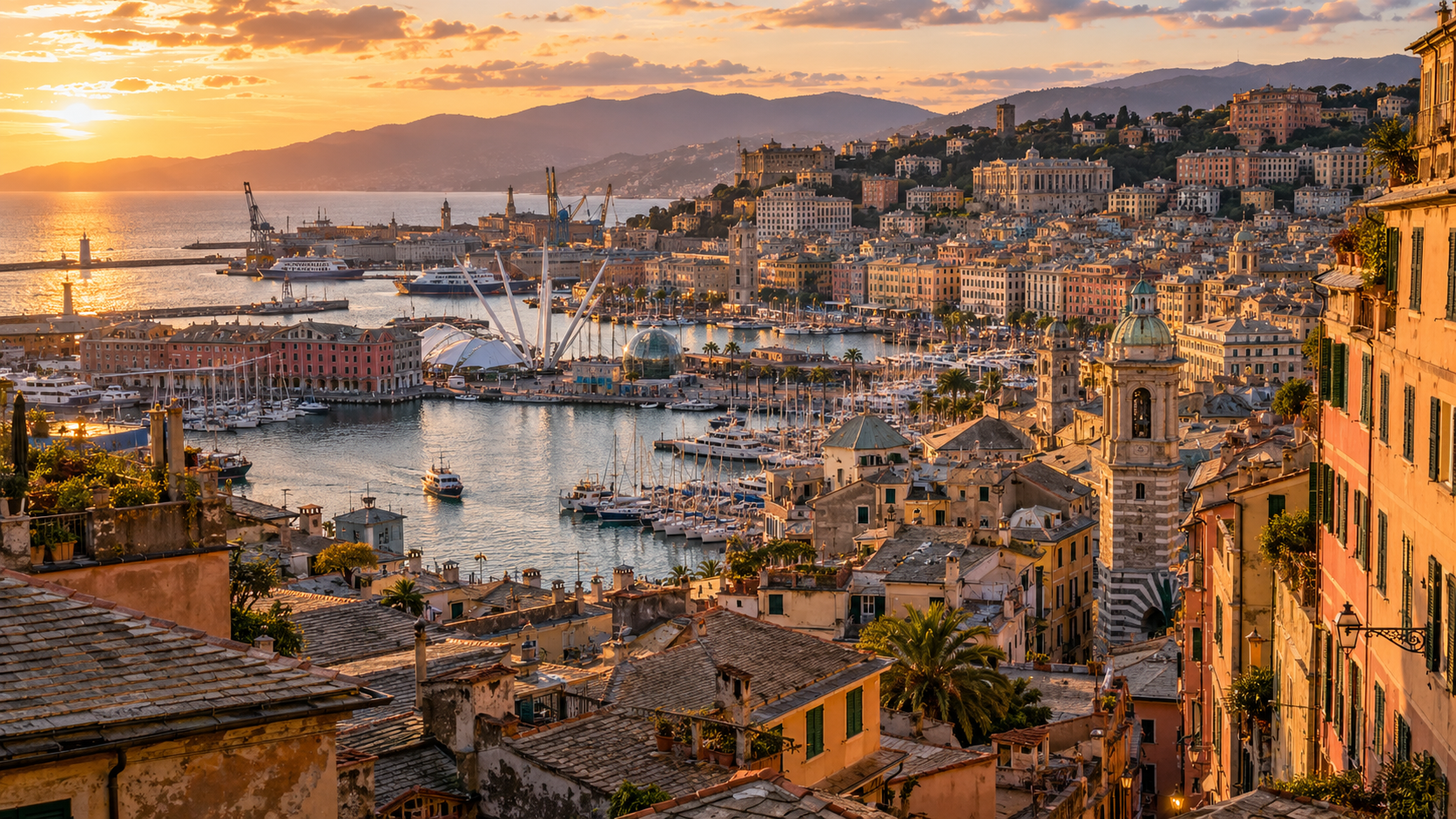
This old port city on Italy’s Ligurian coast is a maze of narrow alleys, grand palaces, faded facades, steep hills, sea views, working docks, tiny bakeries and streets that suddenly open onto something beautiful when you least expect it.
For American travelers searching for genoa italy, the city can be a surprise because it rarely appears at the top of the classic Rome-Florence-Venice itinerary.
That may be a good thing.
Genoa feels lived in. Ferries come and go. Laundry hangs above narrow streets. Locals stop for focaccia in the morning. Motor scooters squeeze through spaces that do not look wide enough for a bicycle. A palace entrance can hide behind a street that looks completely ordinary.
It is historic, wealthy, gritty and elegant all at once.
And yes, pesto really does taste different here.
Where exactly is Genoa?
Genoa sits on the Ligurian Sea in northwestern Italy, roughly between the French border and Tuscany.
It is the capital of the Liguria region and one of Italy’s most important port cities.
The geography is unusual.
The city is squeezed between mountains and the sea, so instead of spreading neatly across flat land, Genoa climbs.
Neighborhoods rise above the waterfront. Roads twist around hills. Funiculars and elevators become actual public transportation rather than tourist novelties.
This vertical layout shapes the whole experience.
You may start beside the harbor, walk through the medieval center, climb toward an elegant residential street and suddenly find yourself looking over rooftops toward the Mediterranean.
| Area | What It Feels Like | Why Go |
|---|---|---|
| Historic Center | Dense, atmospheric, medieval | Alleys, churches, food shops and hidden palaces |
| Via Garibaldi | Grand, elegant, aristocratic | Palazzi dei Rolli and museum collections |
| Porto Antico | Open, lively, waterfront | Aquarium, harbor walks and family-friendly attractions |
| Boccadasse | Small, colorful, seaside | Sunset, gelato and an easy coastal escape |
| Castelletto | Residential, elevated, scenic | Panoramic city and harbor views |
| Nervi | Green, coastal, relaxed | Parks, sea walks and a quieter afternoon |
That mix makes Genoa feel less like a single attraction and more like a city you slowly decode.
The old town is the main event
Genoa’s historic center is one of the largest medieval urban cores in Europe, and it feels dense almost immediately.
The narrow lanes are called caruggi.
Some are bright and busy. Others are barely wide enough for sunlight to reach the pavement.
You walk past bakeries, tiny groceries, churches, apartment entrances, bars and old storefronts. Then a doorway opens into a marble staircase that looks like it belongs inside a palace.
Sometimes it does.
The fun is in the contrast.
Do not rush through the old town with your phone permanently open to navigation.
Use a map when you need it, obviously. But allow a few wrong turns.
Genoa is unusually good at rewarding them.
Via Garibaldi is where the city’s old money shows up
Then you reach Via Garibaldi and the city suddenly changes personality.
The street is lined with monumental Renaissance and Baroque palaces built by powerful Genoese families during the city’s great period of wealth.
These residences formed part of the Palazzi dei Rolli system.
The idea was unusual: prestigious private homes were placed on official lists and could be called upon to host important state visitors such as princes, ambassadors and other high-ranking guests.
In 2006, UNESCO recognized the Strade Nuove and Palazzi dei Rolli as a World Heritage property.
Today, 42 palaces are included in the UNESCO site.
Some are museums. Others remain private, institutional or partly accessible.
And this is where Genoa becomes slightly sneaky.
You can walk through a narrow medieval street that feels almost rough, turn one corner, and suddenly face a grand facade built to impress royalty.
The Rolli palaces are more interesting than they sound
“Historic palaces” can sound like the kind of travel stop where you walk through five rooms and forget everything by lunch.
These are different because they reveal how wealthy Genoa once was.
The city became a major maritime and banking power. Its elite families built homes with monumental staircases, painted ceilings, internal courtyards and elaborate galleries.
Some of the most accessible buildings are part of the Museums of Strada Nuova, including Palazzo Rosso, Palazzo Bianco and Palazzo Tursi.
Even if you do not consider yourself an art person, the buildings themselves are worth seeing.
Look at the staircases.
Look at the courtyards.
Look upward.
Genoa hides some of its best architecture above eye level.
Porto Antico is Genoa’s easier side
After the dark caruggi, the Porto Antico feels almost shockingly open.
This redeveloped harbor area sits beside the historic center and gives you space, sea air and broad views across the port.
Families walk here. Boats come and go. Cafés and attractions cluster around the waterfront.
The area was heavily redeveloped around the 1992 Columbus celebrations, with major involvement from Genoese architect Renzo Piano.
Today it works as one of the city’s easiest visitor zones.
You can walk straight from the old town to the harbor in minutes.
That proximity makes Genoa feel very compact despite its complicated geography.
The Aquarium is not just for kids
The Aquarium of Genoa is one of the city’s most famous attractions and one of the major aquariums in Europe.
Families naturally make up a big part of the audience, but you do not need children as an excuse to go.
The exhibits focus on marine environments and aquatic species, and the visit can easily take a few hours.
It is especially useful on a rainy or extremely hot day when walking another six miles through stone streets starts sounding less charming.
Still, if you only have one day in Genoa and history is your priority, I would not make the aquarium your first stop.
The city itself is more unusual.
Christopher Columbus is part of the local story
Genoa is traditionally associated with Christopher Columbus, who was born in the Republic of Genoa.
You will see references to him around the city, including the reconstructed or traditionally identified house near Porta Soprana.
For American visitors, the name carries a much more complicated cultural weight than it did in older tourism material.
So it helps to treat the site historically rather than as hero worship.
The more interesting point is that Columbus emerged from a maritime society where ships, merchants and Mediterranean trade were part of everyday economic life.
Genoa helps explain that context.
San Lorenzo Cathedral looks dramatic without trying too hard
The Cathedral of San Lorenzo sits close to the heart of the historic center.
Its striped black-and-white stone facade is immediately recognizable, especially when you approach it through the surrounding narrow streets.
Inside, the building combines layers of architecture and religious history accumulated over centuries.
The contrast between the dark caruggi and the open cathedral square makes the arrival more dramatic.
And this is one of Genoa’s recurring strengths.
Big spaces appear suddenly.
Now we need to talk about focaccia
Breakfast in Genoa may ruin plain toast for you.
Focaccia genovese is one of the foods most closely tied to the city.
It is flat, soft inside, lightly crisp on top and generous with olive oil and salt.
The surface is dimpled, allowing oil and brine to settle into the dough.
Locals may eat focaccia in the morning, sometimes even dipping it into cappuccino.
Yes, really.
If you’re American, the combination may feel like somebody broke a breakfast rule.
Try it before judging.
Pesto here is not the jar in your refrigerator
Pesto alla genovese is another obvious one.
The traditional sauce centers on basil, pine nuts, garlic, hard cheese, olive oil and salt.
The exact balance matters.
Good pesto is fragrant and fresh rather than heavy and oily.
In Liguria, it is often served with pasta shapes such as trofie or trenette. You may also see potatoes and green beans incorporated into the dish.
That sounds strange until it arrives.
Then it makes perfect sense.
One warning: pesto oxidizes. Its color changes when exposed to air.
So do not assume the brightest neon-green sauce is automatically the most authentic-looking option.
What else should you eat?
Liguria’s cuisine reflects its geography.
The region has mountains pressing close to the coast, limited flat farmland and a long maritime tradition.
That encourages a kitchen built around herbs, vegetables, olive oil, fish, chickpea flour and creative ways to stretch simple ingredients.
- Try focaccia genovese early in the day when bakeries are busy.
- Order trofie or trenette with pesto at least once.
- Look for farinata, a thin savory pancake made from chickpea flour.
- Try pansoti, stuffed pasta often served with a walnut sauce.
- Eat seafood when the menu and season make sense.
- Do not ignore simple vegetable pies and bakery snacks.
Farinata deserves extra attention.
It looks almost too simple: chickpea flour, water, olive oil and salt baked into a thin, lightly crisp pancake.
Then you eat it hot from the oven.
Suddenly simple sounds smarter.
Boccadasse feels like someone hid a fishing village inside the city
One of Genoa’s easiest escapes is Boccadasse.
This small former fishing village sits along the eastern side of the city, with pastel houses gathered around a pebble beach.
It is tiny.
Do not build an entire day around it unless your plan is basically lunch, beach, gelato and staring at the sea.
Actually, that is not a bad plan.
Boccadasse works best in the late afternoon or evening when the light softens and locals join visitors along the waterfront.
From central Genoa, it feels surprisingly far removed from the port and medieval alleys despite still being part of the city.
Take the elevator to Castelletto
This is one of those tiny Genoa experiences that is disproportionately satisfying.
The city has public elevators and funiculars because steep hills are part of normal life.
The historic elevator from Piazza Portello toward Spianata Castelletto brings you up to one of the best panoramic viewpoints over the city.
From above, Genoa finally becomes understandable.
You see tiled roofs packed toward the harbor, church domes, port infrastructure, hills and the sea.
At street level the city feels like a maze.
From Castelletto it looks like someone actually had a plan.
Nervi is another version of Genoa
Continue east and Genoa becomes greener and more coastal.
Nervi is known for parks, villas and the seaside promenade called Passeggiata Anita Garibaldi.
The path follows the rocky coast with open sea views.
It is especially nice when the weather is clear and you want something less dense than the historic center.
Visitors often underestimate how long Genoa stretches along the coast.
The city is not just one old harbor surrounded by apartment blocks.
Its eastern neighborhoods can feel almost resort-like in places.
Genoa rewards walkers – but bring proper shoes
The historic center is highly walkable.
That does not mean it is physically effortless.
Stone streets, slopes, staircases and changing elevation add up.
If your footwear only works on perfectly flat hotel carpet, this is the wrong city to test it.
A useful first-day route could look like this:
- start around Piazza De Ferrari and the cathedral area;
- walk into the historic center through the caruggi;
- continue toward Via Garibaldi and the Palazzi dei Rolli;
- drop down toward Porto Antico;
- take a break for focaccia or farinata;
- finish with the Castelletto viewpoint or the waterfront.
That gives you a good first impression without turning the day into an endurance event.
Is Genoa safe to walk around?
Like any major port city, Genoa changes block by block.
The central tourist areas are busy, and normal city awareness is appropriate.
Keep an eye on your belongings in crowded streets and public transport.
Some narrow streets can feel darker or rougher at night than visitors expect, especially if you wander without knowing the area.
That does not mean the historic center should be avoided.
It means use ordinary urban judgment.
If a street feels uncomfortable, take the next one.
There are usually several.
Public transportation makes sense once you accept the hills
Genoa has buses, a metro, funiculars and public elevators.
The metro is relatively compact compared with systems in Rome, Paris or New York, but it connects several central and useful areas.
Buses do much more of the citywide work.
The funiculars and elevators are particularly Genoese.
They are not just cute transportation for tourists.
They solve the basic problem of living in a city built against mountains.
| Transport | Useful For | What to Know |
|---|---|---|
| Walking | Historic center and waterfront | Best way to explore, but expect slopes and stairs |
| Metro | Selected central routes | Simple and useful, but not extensive |
| Bus | Most city neighborhoods | Main public transport for many routes |
| Funicular | Hill neighborhoods | Practical transport with scenic value |
| Public elevator | Fast elevation changes | Very useful in a vertical city |
| Train | Coastal day trips | Excellent for towns along the Ligurian coast |
Genoa is a great base for Liguria
This may be one of the city’s biggest advantages.
Stay in Genoa and you can use regional trains to explore the Ligurian coast without changing hotels constantly.
Camogli, Santa Margherita Ligure and other coastal towns are relatively easy additions depending on schedules.
Portofino requires an extra connection because it does not have its own train station, but the surrounding area is still practical as a day trip.
Cinque Terre is farther away but possible by train.
Would I recommend commuting to Cinque Terre every single day?
No.
But for one long day, Genoa can work as a base.
Camogli may be the day trip that surprises you most
Camogli sits east of Genoa and has the kind of waterfront many people imagine when they picture Liguria.
Tall colorful buildings rise behind a pebble beach. Fishing boats sit near the harbor. Restaurants face the sea.
It is more relaxed than Portofino and often feels less like it was designed entirely for luxury travel photography.
That makes it easy to enjoy.
Go for lunch, walk the waterfront and return to Genoa in the evening.
Not every day trip needs fifteen attractions.
Portofino is beautiful, but keep your expectations realistic
Portofino is famous for a reason.
The tiny harbor framed by pastel buildings is genuinely picturesque.
It is also expensive, polished and heavily visited.
The town itself is small.
The better experience often comes from combining Portofino with walking routes, nearby Santa Margherita Ligure or coastal viewpoints rather than expecting the harbor alone to fill an entire day.
Go. See it.
Just don’t confuse fame with size.
What about Cinque Terre?
Cinque Terre lies southeast of Genoa along the Ligurian coast.
The five villages – Monterosso al Mare, Vernazza, Corniglia, Manarola and Riomaggiore – are connected primarily by rail and hiking routes.
Genoa is not the closest base, but direct or connecting trains can make a day trip possible.
If Cinque Terre is the main reason you’re visiting Liguria, staying closer may make more sense.
If Genoa is your priority and you simply want one coastal excursion, then the train works.
When is the best time to visit Genoa?
Spring and early fall are hard to beat.
April, May, June, September and early October often provide comfortable conditions for walking around the city and exploring the coast.
Summer brings beach weather and a lively waterfront, but July and August can feel hot and humid.
They are also busy months along Liguria.
Winter is quieter.
The city continues functioning normally because Genoa is not a seasonal resort, although beach-town energy drops and coastal weather can be cool, windy or wet.
For museums, food and urban exploring, that can actually be appealing.
How many days do you need?
Two full days is enough to understand the basics.
Three is better.
With three days, you can explore the historic center, spend time around the harbor and palaces, then use part of a day for Boccadasse, Nervi or another coastal neighborhood.
Four or five days lets you add a proper Ligurian day trip without treating Genoa itself as the hotel lobby between train rides.
A reasonable first visit might look like this:
- Day one: historic center, cathedral, Palazzi dei Rolli and Porto Antico.
- Day two: museums, Castelletto, local food and Boccadasse.
- Day three: Nervi or a coastal day trip such as Camogli.
- Day four: optional Portofino, Santa Margherita Ligure or another Ligurian town.
Notice what is missing?
Hourly scheduling.
Genoa gets better when you leave time to wander.
What Americans often get wrong about Genoa
The first mistake is assuming it is just a cruise port.
Ships do use Genoa, obviously. But the city has centuries of maritime, financial and architectural history that deserve more than a bus ride from the terminal.
The second mistake is expecting polished Italian beauty everywhere.
Some buildings look worn. Graffiti exists. Certain streets feel gritty.
That does not cancel out the city.
It is part of why Genoa feels less staged.
The third mistake is skipping it for smaller Ligurian towns.
Camogli and Portofino are beautiful. Genoa offers something they cannot: the depth of an actual historic city.
FAQ About Genoa Italy
Is Genoa Italy worth visiting?
Yes. Genoa is especially rewarding for travelers who enjoy historic streets, architecture, local food, maritime history and cities that feel less polished than Italy’s most famous tourist centers.
How many days do you need in Genoa?
Two days covers the main sights, while three days gives you enough time for the historic center, palaces, harbor, food and a coastal neighborhood such as Boccadasse or Nervi.
What is Genoa famous for?
Genoa is known for its historic port, medieval center, Palazzi dei Rolli, pesto, focaccia, maritime history and its long role as a major Mediterranean trading city.
Is Genoa close to Cinque Terre?
Yes, but it is not the closest base. Regional trains connect Genoa with the Cinque Terre area, making a day trip possible, though staying closer is easier if the five villages are the main focus of your trip.
What food should I try in Genoa?
Try focaccia genovese, pasta with pesto, farinata, pansoti with walnut sauce and Ligurian seafood. Bakery counters are also worth exploring rather than saving every meal for formal restaurants.
Is Genoa walkable?
The historic center is very walkable, but Genoa is hilly. Public elevators, funiculars and buses are helpful when moving between the waterfront and higher neighborhoods.
What is the best time to visit Genoa?
Late spring and early fall are excellent for walking and coastal trips. Summer is lively but hotter and busier, while winter offers a quieter city experience.
Genoa Is Better Once You Stop Comparing It to Other Italian Cities
Genoa has spent a long time living in the shadow of prettier travel stars.
Florence has Renaissance art.
Venice has canals.
Rome has ancient monuments.
The Ligurian coast has Portofino and Cinque Terre.
So Genoa sometimes gets reduced to the place with the airport, the ferry terminal or the train station you pass through on the way somewhere prettier.
That is the wrong way to see it.
Genoa’s appeal comes from friction.
A dark medieval lane opens onto a marble palace. A rough port sits beside elegant Renaissance architecture. A baker sells focaccia a few steps from a building where one of Europe’s richest families once entertained diplomats.
The city climbs from the sea and forces you to move differently.
You walk.
You get lost.
You take an elevator because the next street is somehow fifty feet above your head.
You eat pesto where pesto actually comes from.
You sit beside the harbor and remember that Genoa was looking outward toward the Mediterranean long before tourism existed.
And maybe that’s what makes genoa italy such a good second- or third-trip Italian destination.
It does not give you the obvious version of Italy.
It gives you a working city with old wealth, maritime history, steep streets, strong food traditions and neighborhoods that reveal themselves slowly.
So don’t hurry through it on the way to Cinque Terre.
Stay two or three nights.
Walk the caruggi.
Look inside the palace courtyards.
Eat focaccia before noon.
Ride up to Castelletto and look back toward the sea.
Then take the train somewhere smaller the next day.
Genoa is not Italy’s easiest city.
That’s part of why it sticks with you.

Leave a Reply