
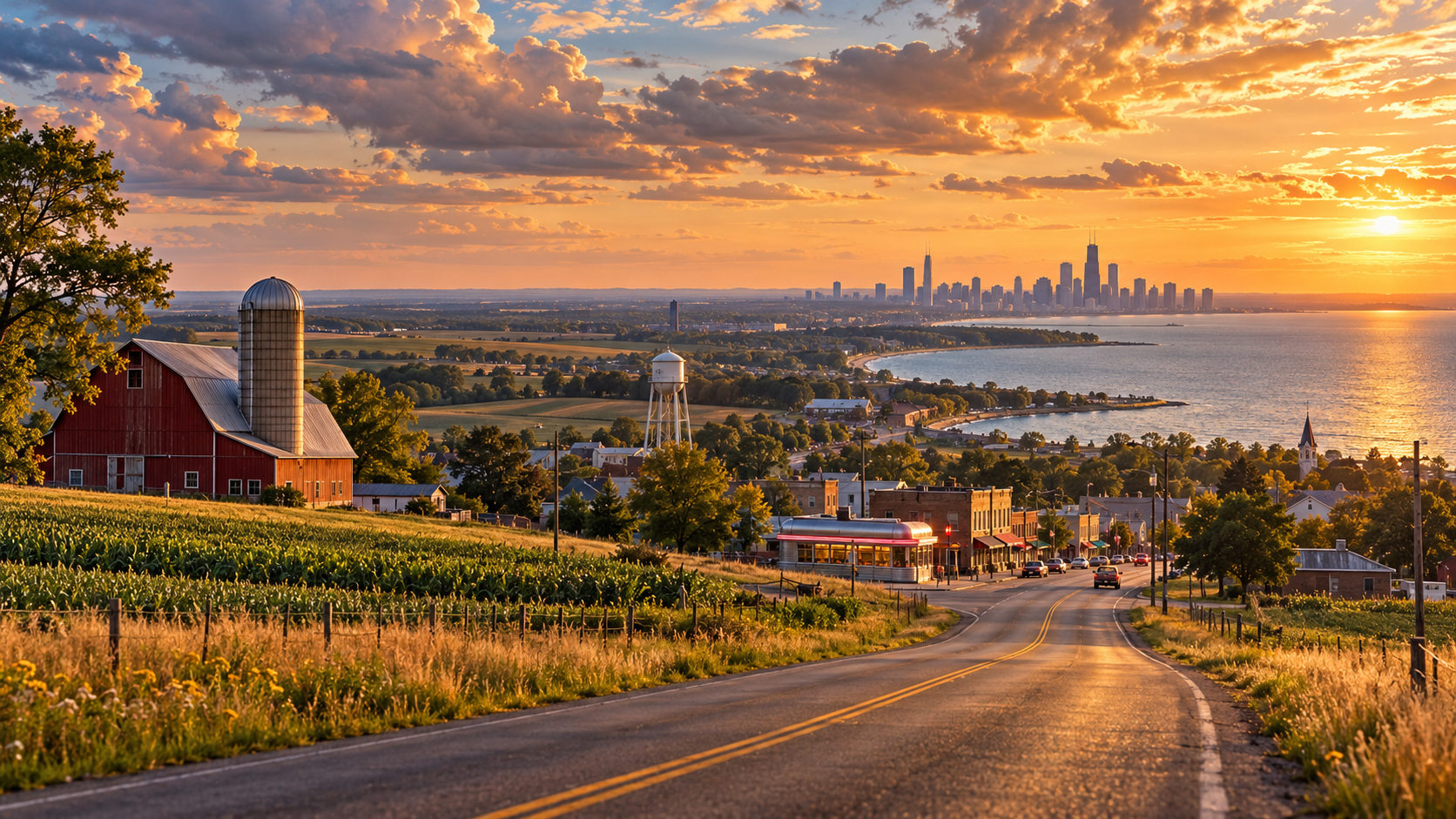
Say “heartland america” and a certain picture usually appears.
Cornfields. Red barns. A water tower with a town name painted across the side. Maybe a two-lane highway disappearing into flat farmland while a country song plays somewhere in the background.
That picture exists.
It just leaves out Chicago skyscrapers, Great Lakes beaches, old industrial neighborhoods, North Dakota badlands, Minnesota forests, Kansas City barbecue, Detroit architecture, Wisconsin supper clubs and college towns where half the population seems to own a bicycle.
The American heartland is difficult to define because it is not an official region with one neat border. People often use the term for the Midwest and Great Plains, though the meaning shifts depending on who’s talking.
For this guide, think of Heartland America as the broad central stretch of the country – especially the Midwest and parts of the Great Plains – where major cities, farming regions, industrial history, inland lakes and prairie landscapes overlap.
And honestly, that’s far more interesting than the cornfield cliché.
So what exactly counts as Heartland America?
There is no government map labeled “Heartland America.”
The closest clean geographic reference is the U.S. Census Bureau’s Midwest region. It includes Illinois, Indiana, Michigan, Ohio, Wisconsin, Iowa, Kansas, Minnesota, Missouri, Nebraska, North Dakota and South Dakota.
Everyday use of “heartland” can stretch farther, sometimes pulling in nearby Great Plains or border states. That looseness is part of the term.
It describes a cultural idea as much as a map.
Still, even the official Midwest is far from uniform.
| Area | What You Might Picture | What You Actually Find |
|---|---|---|
| Great Lakes | Cold water and old factories | Beaches, islands, dunes, big cities and forests |
| Great Plains | Endless flat farmland | Prairie, badlands, ranch country and dramatic skies |
| Upper Midwest | Snow and dairy farms | Lakes, cabins, Scandinavian heritage and strong food traditions |
| Industrial Midwest | Rust Belt cities | Architecture, museums, music history and revitalized neighborhoods |
| Missouri and Kansas | Farm country | Barbecue, jazz history, prairie and major urban areas |
That variety is what makes the region worth exploring.
A Minnesota lake town and downtown Detroit may both sit inside the broader heartland story, but they do not feel remotely alike.
Chicago is a pretty good place to break the stereotype
If your image of the Midwest involves tractors, begin in Chicago.
The skyline rises beside Lake Michigan with some of the most influential architecture in the United States. The city’s neighborhoods hold deep Polish, Mexican, Black, Irish, Ukrainian, Chinese, Puerto Rican and other cultural histories.
You can spend the morning looking at modern architecture from the river, eat lunch in a neighborhood miles from downtown and finish the evening beside a lake so large that your brain keeps trying to call it an ocean.
And yes, Lake Michigan really does have beaches.
This surprises more first-time visitors than it probably should.
On a warm summer day, people swim, play volleyball and sit on sand while skyscrapers rise in the background. That combination feels slightly unreal the first time you see it.
The Great Lakes are basically inland seas
The word “lake” doesn’t prepare you for them.
The five Great Lakes – Superior, Michigan, Huron, Erie and Ontario – form the largest group of freshwater lakes on Earth by surface area.
From many shorelines, you cannot see the other side.
There are waves. Beaches. Lighthouses. Islands. Commercial shipping. Fishing towns.
Lake Superior, in particular, feels wild in a way people who associate the Midwest with farmland may not expect.
Northern Minnesota, Wisconsin and Michigan can give you rocky shorelines, dense forests and water that looks almost Caribbean blue on a clear day – until you stick your foot in it and remember you’re very far north.
The Great Lakes also shaped the industrial history of cities such as Chicago, Milwaukee, Detroit, Cleveland and Toledo.
Water was not just scenery. It was transportation, trade and work.
Michigan has some seriously good beach towns
Another American travel mystery: people will fly across the country for a beach vacation and forget Michigan exists.
The western side of the state has long sandy beaches along Lake Michigan, dune systems, small resort towns and sunsets over the water.
Sleeping Bear Dunes is one of the most dramatic areas, with high dunes overlooking blue lake water.
The Upper Peninsula is a different story entirely.
There, the landscape gets quieter and rougher. Waterfalls, forests and the Lake Superior shoreline dominate. Pictured Rocks National Lakeshore brings together colored cliffs, rock formations, beaches and clear water.
It doesn’t fit the standard Midwestern postcard.
Good.
Detroit deserves a fresh look
Detroit may carry more outdated baggage than almost any American city.
People know the auto industry. They know stories of industrial decline. Some still picture the city through photographs from decades ago.
But Detroit also has exceptional architecture, serious music history, food with strong immigrant influences and neighborhoods that reveal several different versions of the city.
Motown alone changed American popular music.
Then there is techno, which developed into a major cultural movement with deep Detroit roots.
Architecture fans can spend hours looking at Art Deco towers and early skyscrapers downtown.
And one food argument is basically unavoidable: Detroit-style pizza.
It’s rectangular, thick-edged and known for its crisp cheese caramelization along the sides.
Pizza purists may begin debating before the first bite.
Let them.
Food may be the easiest way to understand the heartland
Heartland food has a reputation for being heavy.
Sometimes it absolutely earns that reputation.
Cheese. Beef. Fried things. Casseroles. Sausages. Pie. Potatoes doing heroic amounts of work.
But regional food tells a deeper story about migration, agriculture and local ingredients.
German immigration shaped parts of Wisconsin and Ohio. Scandinavian traditions remain visible in Minnesota. Central and Eastern European communities influenced food in cities across the Great Lakes. Black migration changed northern urban food cultures. Mexican communities have reshaped restaurant scenes from Chicago to small meatpacking towns across the Plains.
The result is much more varied than “meat and potatoes.”
- Try Kansas City barbecue for smoked meats and the city’s own sauce traditions.
- Eat Detroit-style pizza in Detroit rather than judging it from a frozen supermarket version.
- Look for cheese curds, bratwurst and supper clubs in Wisconsin.
- Try a breaded pork tenderloin sandwich in Iowa or Indiana.
- Explore immigrant neighborhood food in Chicago, Cleveland, Detroit and Milwaukee.
- Stop at a small-town diner at least once, preferably somewhere pie is clearly taken seriously.
That last one matters.
A good heartland road trip should probably contain pie.
Kansas City takes barbecue personally
Barbecue debates are one of America’s safest ways to start an argument among otherwise reasonable adults.
Kansas City brings its own strong tradition.
The city’s barbecue culture developed through pitmasters, neighborhood restaurants and a long history of smoking different cuts of meat.
You’ll see ribs, brisket, sausage, pulled pork and the famous burnt ends associated with Kansas City barbecue culture.
Sauces often lean sweet, tangy and tomato-based, though reducing the whole tradition to sauce misses the point.
The smoke comes first.
And this is not one of those foods where you need a white tablecloth to understand it. Some of the most memorable places may look extremely ordinary from outside.
Wisconsin has its own food universe
Wisconsin does not casually like dairy.
It has committed.
Cheese curds are an obvious starting point. Fresh curds can squeak slightly when you bite them. Fried cheese curds take the same concept and add batter because apparently restraint was never invited.
Then there are supper clubs.
These classic Wisconsin restaurants often have a retro, old-school feel, with steaks, fish fries, relish trays and brandy Old Fashioneds closely tied to the experience.
Friday fish fry culture is another regional habit with roots in local religious traditions and community life.
It is social food more than trendy food.
Minnesota’s lake culture is practically a season of its own
Minnesota calls itself the Land of 10,000 Lakes, though the actual number of named lakes is even higher depending on how they’re counted.
For many families, summer means lake time.
Cabins. Docks. Fishing. Canoes. Pontoon boats. Mosquitoes working overtime.
People leave Minneapolis or smaller cities on Friday afternoon and head “up north,” which is less a precise direction than a cultural concept.
The cabin may belong to one family, several relatives or a friend who suddenly becomes everyone’s favorite person in June.
Winter flips the lifestyle.
Lakes freeze. Ice fishing appears. Snowmobiling, cross-country skiing and hockey become part of the rhythm.
Visitors from warmer states sometimes discover that Midwesterners don’t exactly wait for winter to end.
They schedule activities on top of it.
The prairie is not empty
This is probably one of the biggest visual misunderstandings about Heartland America.
Drive across Kansas, Nebraska or the Dakotas and people may call the landscape “nothing.”
Look longer.
Prairie is not empty land waiting for something interesting to happen.
It is an ecosystem.
Native grasslands once covered enormous parts of central North America, supporting bison, prairie dogs, birds and countless plant species. Agriculture transformed much of that landscape, but protected prairie areas still give visitors a sense of its original scale.
Tallgrass Prairie National Preserve in Kansas is one place where you can walk through native prairie rather than simply drive past farmland.
The experience is subtle.
No giant waterfall appears at the end.
Instead, you notice wind moving through grass, changing light and a horizon that feels unusually large.
South Dakota gets dramatic fast
If you think the heartland is visually boring, drive into the Badlands.
Badlands National Park turns the landscape into eroded towers, ridges and sharply carved formations layered in muted reds, browns, grays and yellows.
Bison and bighorn sheep live in the region, and prairie surrounds the formations.
Farther west, the Black Hills rise into forested country.
Mount Rushmore is the famous name, but it is far from the only reason to visit. Wind Cave National Park, Jewel Cave National Monument and scenic drives provide a much wider picture of the region.
And this is also Native land with deep cultural significance.
Any serious understanding of the American heartland has to include Indigenous history rather than beginning the story when European-American settlers arrived.
Native American history is central, not an optional sidebar
The central United States has been home to Indigenous nations for thousands of years.
Plains, woodland and Great Lakes cultures developed distinct languages, trade networks, agricultural practices, spiritual traditions and political systems long before the modern states existed.
That history remains alive.
Tribal nations and Indigenous communities continue across the Midwest and Plains today.
National Park Service sites including Pipestone National Monument in Minnesota and Knife River Indian Villages in North Dakota help visitors understand parts of this history, but museums and archaeological sites are only one piece.
Modern Native communities are not historical exhibits.
That sounds obvious, yet travel writing has not always acted like it is.
Small towns are part of the story – but don’t romanticize them
Yes, small-town America exists.
There are county fairs, high school football games, farmers markets, diners where servers know half the customers, grain elevators and main streets where the hardware store has been around longer than anyone can remember.
But small towns are not frozen in 1955.
Some have grown around manufacturing or logistics. Others have lost population. Some are becoming more diverse because of new immigrant communities. College towns may feel young and progressive. Tourist towns can be surprisingly expensive.
The heartland is not culturally uniform just because buildings are shorter.
That’s one reason road trips can be interesting.
You see the changes mile by mile.
College towns add a completely different rhythm
Places such as Madison, Wisconsin; Ann Arbor, Michigan; Iowa City, Iowa; Lawrence, Kansas; and Lincoln, Nebraska bring universities into the center of local life.
That means bookstores, live music, coffee shops, student bars, museums, sports and an unusually large population of people carrying laptops at all times.
Game day can temporarily reorganize the whole city.
If you’re visiting in fall and see everyone wearing the same color at 8 a.m., something is happening.
Probably football.
Fall may be the heartland’s best season
Summer is popular for lake trips and road travel. Winter has its own appeal.
But fall is hard to beat.
September and October can bring cooler temperatures, changing leaves, harvest festivals, college football and some of the easiest road-trip weather of the year.
Northern Michigan, Minnesota and Wisconsin can produce excellent fall color.
Farther south, the season tends to arrive later.
And across agricultural areas, harvest changes the entire feel of the landscape.
| Season | What It Feels Like | Best For |
|---|---|---|
| Spring | Green, changeable, sometimes stormy | City trips, prairie flowers, lighter crowds |
| Summer | Warm to hot, lively, humid in many areas | Great Lakes, cabins, festivals, road trips |
| Fall | Cooler, colorful, harvest season | Road trips, hiking, college towns |
| Winter | Cold to extremely cold depending on location | Hockey, snow sports, cozy city weekends |
Weather deserves respect here.
Summer thunderstorms can develop quickly. Tornado risk exists in parts of the Plains and Midwest. Winter storms can affect roads and flights.
Check conditions rather than assuming a giant region has one forecast.
Road trips make more sense here than attraction hopping
Heartland America was practically built for long drives.
Not because every road is beautiful every second.
Some stretches are extremely straight. Very straight.
But driving lets you understand how cities, farm towns, rivers, plains and industrial areas fit together.
A few road-trip ideas work especially well:
- Chicago to Milwaukee and along the Lake Michigan shoreline;
- Detroit through northern Michigan toward the Upper Peninsula;
- Minneapolis toward Lake Superior and Minnesota’s North Shore;
- Kansas City through the Flint Hills and Tallgrass Prairie country;
- Black Hills, Badlands and western South Dakota;
- Great River Road sections following the Mississippi through Midwest towns.
Do not overplan the stops.
Half the point of a road trip is seeing a sign for something strange and deciding you apparently need to know more.
The Mississippi River connects a huge part of the region
For centuries, the Mississippi has shaped trade, settlement and city growth through central America.
Minneapolis and St. Paul sit near its upper reaches. Farther south, cities and towns developed around river transport and commerce.
Driving portions of the Great River Road gives you a slower version of the heartland.
Bluffs rise above the river in parts of Minnesota, Wisconsin, Iowa and Illinois. Small towns sit beside old bridges and railroad tracks. Bald eagles are common in some stretches, especially during colder months.
The river is not simply a line on the map.
It is one of the region’s organizing features.
Music history runs deeper than country
Country music is part of the broader central American story, but it is hardly the only soundtrack.
Chicago helped shape blues and house music.
Detroit gave the world Motown and techno.
Kansas City built a major jazz tradition.
Cleveland became strongly associated with rock history.
Minneapolis produced artists and scenes that reached far beyond Minnesota.
Industrial cities became musical cities partly because migration brought people and traditions together.
Again, the heartland gets more interesting when you stop treating it as culturally rural.
What should you actually do on a first heartland trip?
Mix cities with landscape.
That is the simplest answer.
If you only visit Chicago, you have seen one version of the Midwest. If you only drive through farm country, you’ve seen another narrow slice.
Put the two together.
- Spend time in one major city instead of using it only as an airport.
- Get beside one of the Great Lakes and see how enormous it actually feels.
- Drive through prairie rather than assuming farmland tells the entire story.
- Eat regional food where it developed.
- Visit a Native American cultural or historic site with context and respect.
- Leave time for a small town, neighborhood or roadside stop that wasn’t on the original list.
That combination gives you a much better sense of Heartland America than any single monument.
What Americans sometimes get wrong about their own heartland
The first mistake is assuming it is all rural.
Some of America’s largest metropolitan areas are here.
The second is calling it culturally bland.
The region’s food, music and neighborhoods reflect Indigenous history, Black migration, European immigration, Latin American communities and newer arrivals from around the world.
The third mistake is thinking flat means boring.
Prairie rewards a different kind of attention than mountains do.
And the fourth?
Assuming everyone shares the same lifestyle because they live between the coasts.
Chicago and rural Nebraska do not operate as one cultural unit any more than San Francisco and a California farming town do.
FAQ About Heartland America
What does Heartland America mean?
Heartland America is an informal term for the central United States, especially the Midwest and Great Plains. It has no single official boundary, so the exact states included can vary by context.
Which states are officially part of the Midwest?
The U.S. Census Bureau places Illinois, Indiana, Michigan, Ohio, Wisconsin, Iowa, Kansas, Minnesota, Missouri, Nebraska, North Dakota and South Dakota in the Midwest region.
Is Chicago part of America’s heartland?
Yes. Chicago is in Illinois and is the largest city in the Midwest. The idea that the heartland consists only of farms and small towns leaves out a major part of the region.
What is the Heartland known for?
The region is associated with agriculture, Great Lakes cities, prairie landscapes, manufacturing, major rivers, college towns, regional food, sports and a long history of migration and settlement.
What are the best places to visit in Heartland America?
Popular options include Chicago, Detroit, Milwaukee, Minneapolis, Kansas City, the Great Lakes, Badlands National Park, the Black Hills, northern Michigan and prairie areas in Kansas and Nebraska.
What food is typical of the American heartland?
There is no single cuisine. Regional favorites include Kansas City barbecue, Wisconsin cheese curds and fish fries, Detroit-style pizza, pork tenderloin sandwiches, sausages, freshwater fish and many immigrant food traditions.
When is the best time for a Heartland road trip?
Late spring through fall works well for most routes. September and October are especially comfortable in many areas, with cooler weather, fall color and fewer midsummer heat issues.
Heartland America Is Most Interesting Between the Famous Stops
There is no Eiffel Tower of the American heartland.
No single landmark explains the region.
And that may be exactly why a trip through it feels different.
You understand Heartland America gradually.
It’s Chicago appearing above Lake Michigan. A Wisconsin bar serving Friday fish fry. A Minnesota dock at sunset. Wind running through tallgrass in Kansas. Detroit music playing somewhere it was born. A storm building on a Nebraska horizon that suddenly looks three times wider than it did five minutes earlier.
It’s also the small stuff.
A main street bakery opening before sunrise. A football stadium filling on Saturday morning. Someone giving you directions by saying “about an hour west” because distance works differently out here.
A road sign pointing toward a town you have never heard of.
You turn anyway.
The heartland is not one nostalgic version of America preserved between New York and California.
It changes. Cities reinvent themselves. Small towns gain new communities. Farms become larger or disappear. Old industrial buildings become apartments, studios and breweries. Regional food absorbs new influences while people continue arguing about the correct way to make dishes their grandparents ate.
That tension between old and new is part of the appeal.
So if you want to understand heartland america, don’t search for the “most authentic” town.
There isn’t one.
Go to the lake and the prairie.
Spend time downtown and on a two-lane road.
Eat barbecue, cheese curds or a diner breakfast, then try the food of a community that arrived much more recently.
Visit a national park, but also stop where no attraction sign told you to stop.
And give the landscape time.
The heartland rarely shouts for attention.
Look a little longer and it doesn’t need to.

Leave a Reply