
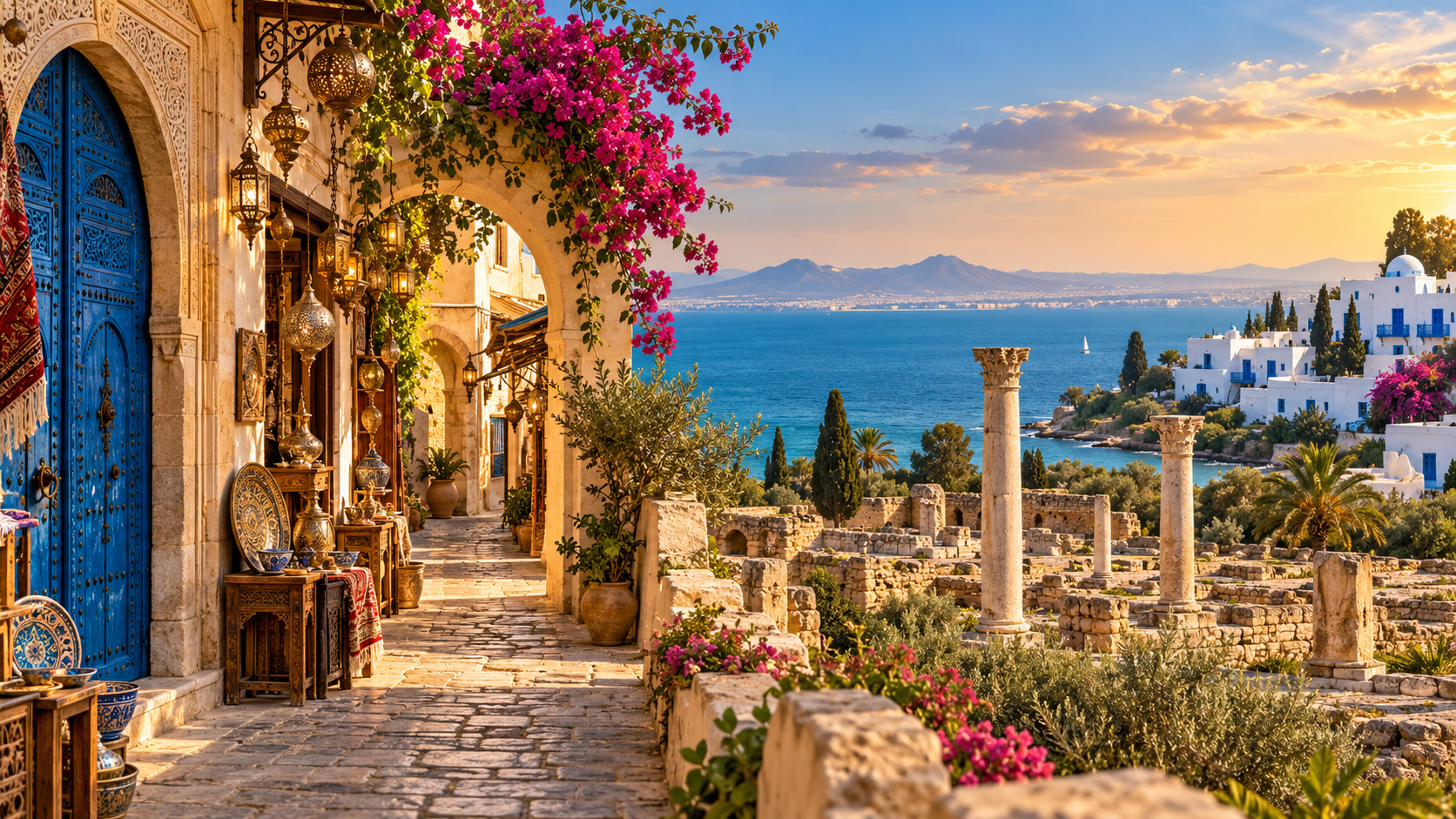
Tunis does not hit you with one giant landmark the second you arrive.
It works more slowly than that.
You walk through the old Medina and suddenly the street narrows into a passage lined with tiny workshops. A few minutes later, you’re drinking strong coffee beside tiled walls. Then the city opens into broad French-era avenues, and by afternoon you can be standing among the ruins of ancient Carthage looking toward the Mediterranean.
That mix is what makes Tunis interesting.
For American travelers, Tunis can feel familiar and unexpected at the same time. There are cafés that could almost belong in southern France, markets that pull you into a very North African rhythm, Roman ruins, Ottoman-era architecture, mosques, seaside suburbs, white-and-blue houses and food that moves between Mediterranean, Arab, Berber and regional Tunisian traditions.
And the best part? Many of the experiences fit together naturally.
You can spend the morning inside the historic center, have lunch over a bowl of couscous or grilled fish, then take a train or taxi toward Carthage and Sidi Bou Said.
That’s a very good day.
First, where exactly is Tunis?
Tunis is the capital of Tunisia, a North African country facing the Mediterranean Sea.
The city sits near the Gulf of Tunis, with suburban areas extending toward the coast and archaeological sites such as Carthage lying northeast of the center.
The location matters.
Tunis does not feel like an isolated inland capital. The sea is nearby, coastal light shapes the atmosphere, and the city’s history has always been connected with Mediterranean trade and movement.
Carthage once became one of the ancient Mediterranean’s great powers. Centuries later, Tunis developed into a major center under Islamic dynasties and eventually became the capital of modern Tunisia.
You can still see those layers without needing an archaeology degree.
| Area | Best Known For | Why Go |
|---|---|---|
| Medina of Tunis | Historic lanes, souks, mosques, old houses | Best place to experience the city’s traditional core |
| Ville Nouvelle | Broad avenues, cafés, European-era architecture | Easy contrast with the Medina and good for walking |
| Carthage | Ancient Punic and Roman ruins | Major historical site overlooking the Gulf of Tunis |
| Sidi Bou Said | White-and-blue architecture, sea views | Relaxed afternoon or sunset stop |
| La Marsa | Coast, restaurants, local seaside life | Good for dinner, beach walks and a slower pace |
| Le Bardo | Museum and history | Strong choice for Roman mosaics and Tunisian heritage |
If you only have two or three days, don’t try to cover all of Tunisia from Tunis.
The city and its immediate surroundings already give you plenty.
The Medina is where Tunis starts feeling like Tunis
The historic Medina is the obvious place to begin.
It is also the easiest place to lose your sense of direction.
That is not necessarily a problem.
The old city is a dense network of streets, lanes, passages, covered market sections, mosques, workshops and historic houses. Some streets feel busy and commercial. Others become almost silent after one turn.
The Medina of Tunis has been on the UNESCO World Heritage List since 1979.
Historically, this was a major Islamic city of North Africa, filled with religious schools, palaces, fountains, markets and residential quarters.
Today, parts of it are still actively lived in and worked in.
That matters because it is not an open-air museum where everyone disappeared centuries ago.
You will see people buying food, repairing metalwork, carrying packages, drinking coffee and opening shops.
Tourists are part of the scene, but not the entire scene.
Don’t rush the souks
The souks are one of the Medina’s most memorable parts.
Different areas historically specialized in particular trades, and you can still notice clusters of similar products in parts of the market.
Perfume. Textiles. Jewelry. Leather. Metalwork. Spices. Traditional clothing.
Some stores are clearly aimed at visitors. Others look like places local families have used for years.
The trick is not to treat the whole Medina as one giant souvenir mall.
Look up.
Old doors, carved stone, painted ceilings and decorative tiles are often hiding above the level where everyone else is staring at handbags.
And yes, bargaining can happen in some shops.
Keep it friendly. A transaction does not need to turn into a competitive sport.
Zitouna Mosque sits at the heart of the old city
The Great Mosque of Zitouna is one of Tunis’s most important religious and historic landmarks.
Its roots go back many centuries, and the mosque became a major center of religious learning in North Africa.
For visitors, access may vary by area and religious practice, so follow posted rules and local instructions.
Dress respectfully and remember the obvious thing people somehow forget in famous religious sites: this is still a place of worship.
Quiet works.
Respect works even better.
The new city is worth your time too
Walk out of the Medina and Tunis changes quickly.
The Ville Nouvelle, or newer European-planned section of the city, has wider streets, cafés, stores and architecture shaped strongly by the French colonial period.
Avenue Habib Bourguiba is the central spine many visitors first encounter.
It is lined with cafés, trees, hotels, commercial buildings and landmarks such as the Cathedral of St. Vincent de Paul.
This part of Tunis has a completely different rhythm from the Medina.
And honestly, that contrast is one of the city’s strengths.
You do not need to pick which side is the “real” Tunis.
Both are.
Carthage is not one ruin
This surprises people.
Say Carthage and you may picture one giant archaeological complex surrounded by a fence.
Not quite.
The archaeological remains are spread across a broad area within modern Carthage.
The site contains evidence from several different historical periods, including Punic, Roman, Paleochristian and later layers.
Ancient Carthage was founded by Phoenicians and eventually became a major Mediterranean trading power. After its wars with Rome, it was destroyed in 146 B.C. A Roman city later rose on the site.
That is why the ruins do not tell one simple story.
They tell several stories stacked on top of each other.
The Antonine Baths show the scale best
The Baths of Antoninus are among the most impressive remains in Carthage.
You mostly see foundations and surviving architectural fragments today, but the footprint makes the original scale easier to imagine.
Roman public baths were not just giant bathrooms.
They were social spaces with heated rooms, cold rooms, exercise areas and elaborate engineering systems.
And here they sit practically beside the sea.
Bring water and sun protection during hot months. Archaeological sites tend to offer less shade than visitors imagine when looking at maps from an air-conditioned hotel room.
Byrsa Hill gives you the bigger picture
Byrsa Hill is another useful stop because it combines archaeological remains with broader views over the surrounding area.
This was one of ancient Carthage’s most important locations.
Today the hill helps you understand why the city developed here in the first place.
You can see the sea, modern neighborhoods and pieces of ancient history within the same frame.
It is one of those places where geography suddenly explains history better than a long paragraph does.
Sidi Bou Said looks almost too polished
Then you arrive in Sidi Bou Said and everything turns white and blue.
Whitewashed walls. Bright blue doors. Blue window frames. Bougainvillea. Sea views.
It is one of Tunisia’s most photographed places, and yes, parts of it feel deliberately postcard-ready.
Still, it works.
The village sits above the Gulf of Tunis and has long attracted artists, writers and visitors.
Walk uphill through the lanes, stop for a drink, look toward the water and accept that you’ll probably take more photos than you planned.
Just do not mistake the whole place for an empty movie set.
People live here.
Try mint tea with pine nuts
One small experience that sticks with many visitors is Tunisian mint tea served with pine nuts floating on top.
It is sweet, fragrant and slightly unexpected if you’re used to plain mint tea.
In Sidi Bou Said, the experience can feel borderline cliché.
Have it anyway.
Sometimes the famous thing is famous because it is pleasant.
La Marsa gives you a more everyday seaside mood
If Sidi Bou Said feels like the carefully dressed cousin, La Marsa feels more relaxed.
The coastal suburb has restaurants, cafés, beaches and residential areas, and it is a good place to slow down after sightseeing.
You may see families walking beside the sea, teenagers meeting friends, people sitting with coffee and restaurants filling for dinner.
This is a useful reminder that Tunis is not only archaeological sites and old markets.
It is also a living Mediterranean capital with people doing normal evening things.
The Bardo Museum deserves serious time
If Roman mosaics sound like something you would normally walk past in ten minutes, the Bardo Museum may change your mind.
The museum is famous for its collection of mosaics discovered at archaeological sites across Tunisia.
And scale matters again.
Some works are huge. Others show tiny details of mythology, animals, daily life and decorative patterns.
The museum also provides a broader route through Tunisian history beyond Rome, with collections tied to different periods and cultures.
Do not schedule it for the final exhausted hour of a packed sightseeing day.
Your feet will lose the argument.
Tunisian food deserves more attention than it gets
North African food often gets flattened into one vague category in American conversations.
Tunisian food is very much its own thing.
It can be spicy. Harissa – a chili paste associated strongly with Tunisia – appears in countless contexts.
Couscous is important, but it is far from the whole menu.
You may encounter grilled fish, lamb, seafood, tomatoes, peppers, olive oil, eggs, chickpeas and preserved ingredients in dishes shaped by Mediterranean and North African traditions.
A few things worth trying:
- brik, a thin crisp pastry often filled with egg, tuna or other ingredients;
- Tunisian couscous with vegetables, meat or seafood;
- lablabi, a chickpea-based dish commonly eaten with bread and seasonings;
- ojja, often made with tomatoes, peppers, eggs and sometimes merguez;
- grilled fish and seafood in coastal areas;
- makroudh or other North African pastries if you want something sweet.
And harissa?
Start cautiously if you do not usually eat spicy food.
Your confidence is not a seasoning.
Brik looks simple and then becomes addictive
Brik is one of those foods that sounds almost too basic on paper.
A very thin pastry sheet is filled, folded and fried.
Egg is a common filling, often combined with tuna, herbs or other ingredients.
The trick is the contrast: crisp pastry outside, softer filling inside.
Eat it while it is hot.
This is not a meal that improves after twenty minutes of taking photos.
Lablabi is comfort food with personality
Lablabi starts with chickpeas and bread but quickly becomes more interesting.
Seasonings can include cumin, harissa, garlic, olive oil and lemon, with additions varying by place and preference.
It is warming, filling and very far from the delicate small-plate image some travelers associate with Mediterranean dining.
This is proper comfort food.
Coffee culture is part of the city rhythm
Cafés are everywhere in Tunis.
Some feel traditional and male-dominated. Others look modern and cosmopolitan. Many sit somewhere in between.
Coffee may be strong and small. Tea can be very sweet.
And social life tends to stretch around the table.
For American travelers used to carrying coffee in a paper cup while walking, this can require a small mental reset.
Sitting is allowed.
No productivity required.
What should you buy in Tunis?
The Medina makes shopping tempting.
Very tempting.
But it helps to know what has some connection to local craft traditions rather than grabbing the first object with “North African” vibes.
- ceramics and painted pottery;
- olive-wood kitchen items;
- traditional textiles or woven goods;
- leather products;
- spices and harissa products suitable for travel;
- jewelry and metalwork from reputable workshops.
Quality varies widely.
If something looks suspiciously identical in twenty stores, it may not be the handcrafted treasure the sales pitch suggests.
How do you get around Tunis?
Tunis has several ways to move around, including taxis, light rail, suburban rail and buses.
For many visitors, taxis are the easiest option for shorter city trips.
The TGM suburban rail line has traditionally connected central Tunis with areas toward La Goulette, Carthage, Sidi Bou Said and La Marsa, although schedules, maintenance and operating conditions should always be checked locally.
For the Medina, walking is best.
A car is mostly a burden inside the old city anyway.
| Transport | Good For | What to Know |
|---|---|---|
| Walking | Medina and central streets | Best for short distances and old-city exploration |
| Taxi | Cross-city trips | Convenient, especially when avoiding heat |
| TGM rail | Carthage, Sidi Bou Said, La Marsa corridor | Useful when operating normally |
| Light rail | Selected urban routes | Practical but may feel less intuitive for first-time visitors |
| Private driver | Full-day sightseeing or airport transfers | More expensive but simple for groups |
When is the best time to visit Tunis?
For many visitors, spring and fall are the easiest seasons.
April, May, October and parts of November often work well for walking, archaeological sites and outdoor meals without peak summer heat.
Summer can be very hot.
That does not make travel impossible, but the rhythm needs to change.
Start earlier. Rest around midday. Drink more water than you think you need. Save long exposed archaeological walks for times when the sun is less aggressive.
Winter is generally mild compared with much of the United States, though days can be cooler, wetter and windy.
This is the Mediterranean, not a year-round beach guarantee.
How many days do you need in Tunis?
Three full days is a solid minimum for a first visit.
That gives you one day for central Tunis and the Medina, one day for Carthage and Sidi Bou Said, and another for the Bardo Museum, La Marsa or whatever you liked enough to revisit.
Four or five days is even better.
You stop sprinting.
You can actually sit down for lunch without checking how many ruins remain on your list.
And you can add an easier day trip outside the capital if you want.
A simple three-day plan actually works
Tunis is one of those cities where a basic structure is useful.
Not an hourly military campaign. Just a rough rhythm.
- Day one: Medina of Tunis, souks, Zitouna area and Ville Nouvelle.
- Day two: Carthage archaeological sites, Sidi Bou Said and dinner around La Marsa.
- Day three: Bardo Museum, relaxed lunch and another neighborhood or coastal stop.
If something takes longer than expected, good.
That’s travel, not failure.
Can you use Tunis as a base for more of Tunisia?
Yes, but be selective.
Tunisia has major archaeological sites, coastal cities, desert landscapes and historic towns spread across the country.
Places such as Dougga or Kairouan can be possible additions depending on transportation and how much time you have.
But don’t turn every day into four hours in a car.
If your trip is only four days long, staying around Tunis and the coast can be far more satisfying than trying to collect half the country.
What about beaches?
Tunis itself is not a classic resort city, but beaches are accessible around the broader coastal area.
La Marsa, Gammarth and other nearby locations offer sea access, while Tunisia’s best-known resort beaches lie farther from the capital.
If your trip is mainly about swimming and resort life, you may prefer another Tunisian coastal base.
If you want history, city life, museums and seaside afternoons in one trip, Tunis works beautifully.
What should American visitors know about etiquette?
Tunis is a cosmopolitan capital, but it is also part of a predominantly Muslim country with local social norms that may differ from those in the United States.
Modest clothing is especially appropriate around mosques and religious spaces.
Ask before photographing people closely.
Greetings matter.
And basic courtesy goes a long way.
You do not need to perform some perfect version of Tunisian etiquette. Just pay attention and avoid treating everyday life like a theme park.
FAQ About Tunis
Is Tunis worth visiting?
Yes. Tunis offers a rare mix of historic Medina streets, museums, Mediterranean city life, Carthage ruins and seaside neighborhoods within a relatively compact region.
How many days do you need in Tunis?
Three days is a good minimum. Four or five gives you more time for museums, Carthage, Sidi Bou Said, coastal areas and slower meals.
Is Carthage close to Tunis?
Yes. Carthage lies northeast of central Tunis and is commonly visited as a half-day or full-day trip together with Sidi Bou Said and La Marsa.
What is Tunis famous for?
Tunis is known for its UNESCO-listed Medina, traditional souks, historic mosques, Bardo Museum, Mediterranean setting and proximity to ancient Carthage and Sidi Bou Said.
What food should I try in Tunis?
Try brik, couscous, lablabi, ojja, grilled seafood, harissa-based dishes and Tunisian pastries. Coffee and mint tea are also part of the everyday experience.
What is the best time to visit Tunis?
Spring and fall are especially comfortable for sightseeing. Summer works too, but heat can make long outdoor visits tiring during the middle of the day.
Can you visit Tunis without renting a car?
Yes. Central Tunis and the Medina are walkable, while taxis and public transport can cover many other trips. A car is not necessary for a typical first visit.
Tunis Works Best When You Let the Layers Overlap
The mistake would be visiting Tunis only for one thing.
Only the Medina.
Only Carthage.
Only Sidi Bou Said because the blue doors looked good online.
The city becomes much more interesting when those pieces sit beside each other.
Walk through a medieval market in the morning. Cross a broad European-style avenue before lunch. Spend the afternoon among Roman ruins beside the Mediterranean. Finish the day with tea in a white-and-blue village above the sea.
That combination should feel chaotic.
Instead, it somehow feels natural.
Tunis has always absorbed different civilizations, religions, languages and architectural styles. Phoenician Carthage existed nearby. Roman Africa flourished here. Islamic Tunis developed its own urban traditions. Ottoman and European influences followed. Modern life simply added another layer.
You still see all of that.
Not perfectly preserved. Not arranged for your convenience.
Just living beside each other.
So when you visit Tunis, resist the urge to sprint through a list.
Get lost in the Medina for a while.
Eat the brik while it is hot.
Look at the mosaics slowly.
Stand beside the ruins at Carthage and actually look toward the water.
Then go drink sweet mint tea somewhere you can see the sea.
That is probably the version of Tunis you’ll remember.

Leave a Reply